
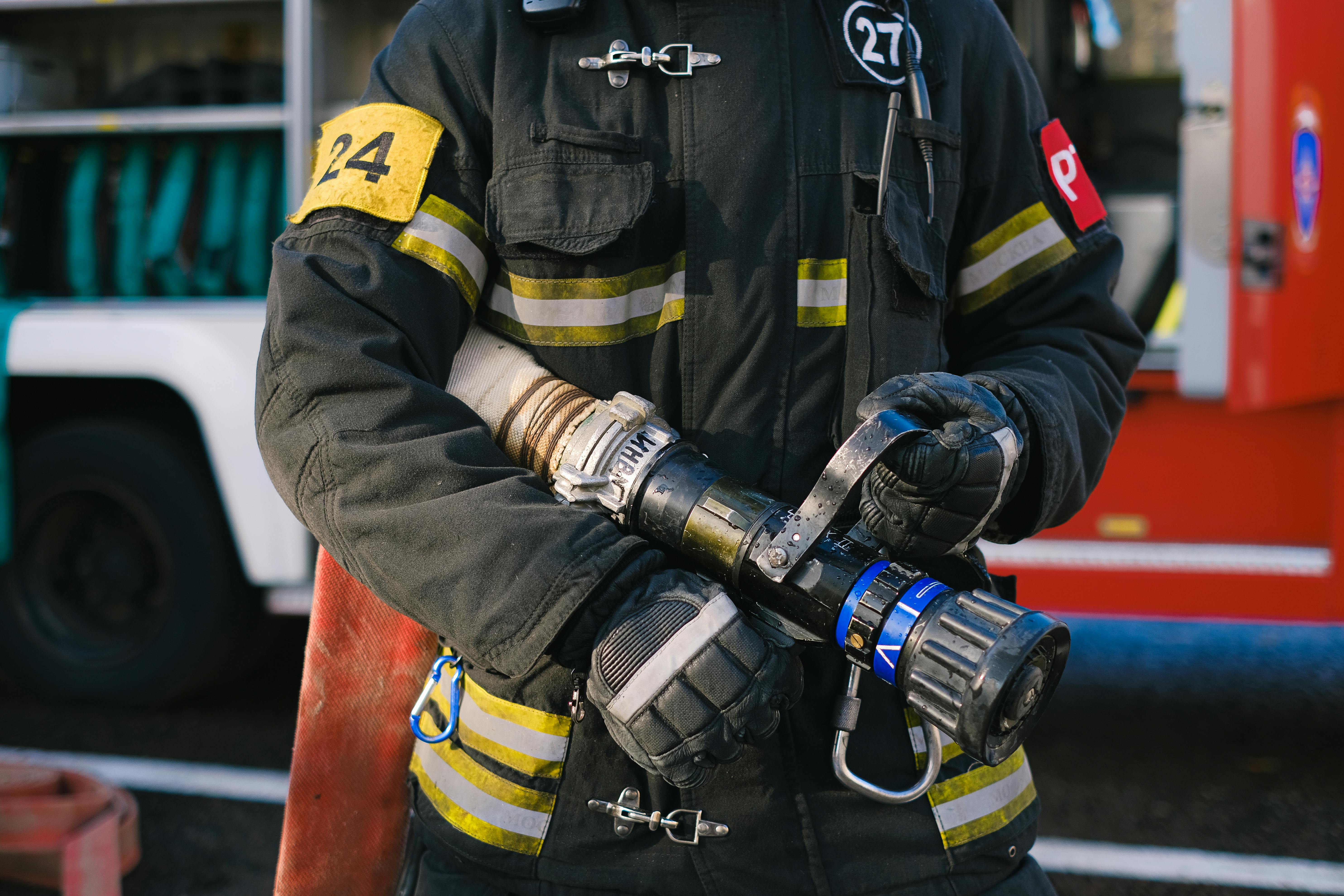
Training Density for Firefighters | Work Capacity Guide
For firefighters, training density, how much work you complete in a fixed window, is one of the most underrated qualities in the gym. Firefighting is one of the most physically demanding occupations in the world: repeated bouts of high effort, short recovery windows, and the ability to perform under heat, stress, and heavy equipment.
In this environment, success isn’t determined by a single lift or a single run.
It’s determined by how much work a firefighter can perform in a short amount of time. This is where training density becomes a critical concept. It also explains why the strongest tactical fitness programs for first responders are built around sustained work capacity, not just peak strength numbers.
What Training Density Means for Firefighters
Training density refers to the amount of work completed within a given time frame.
In firefighting, density shows up in real scenarios like:
Climbing multiple flights of stairs in full gear
Dragging hoses or victims repeatedly
Forcible entry followed by interior search
Operating tools with minimal rest
Working through long, continuous incidents
Unlike controlled gym sessions, fireground tasks often involve:
Minimal recovery
High heat and stress
Continuous output
Heavy external loads
The distinction matters because a gym session lets you dictate the pace, you choose the rest, the load, and when to stop. The fireground does none of that. Tasks stack on top of each other with no regard for how recovered you are, and the clock is set by the incident, not by you. Density training is how you close that gap deliberately, rehearsing compressed work so that when the real call comes, your body already knows how to keep producing output after the easy reserves are gone. Because of this, firefighters must train not only for strength or endurance, but for sustained performance under fatigue.
Why Peak Fitness Alone Isn’t Enough
A firefighter might:
Have a strong deadlift
Run a fast 1.5-mile test
Perform well in a single conditioning event
But still struggle during real operations.
Why?
Because fireground performance depends on:
Repeated efforts
Short recovery periods
Accumulated fatigue
Task transitions
Foundational research by Gledhill and Jamnik (1992) on firefighter physiology found that fire suppression tasks:
Rapidly elevate heart rate
Require high oxygen consumption
Produce significant metabolic stress
Demand sustained work output
The numbers make the point bluntly. Gledhill and Jamnik measured the most demanding fire suppression operations at a mean oxygen cost of roughly 41.5 ml/kg/min, with blood lactate climbing into the 6 to 13 mmol range, territory that signals heavy anaerobic contribution, not steady aerobic cruising. That combination is exactly what density training targets: the ability to keep working as oxygen demand spikes and metabolic byproducts accumulate. A firefighter who only trains for single, well-rested efforts never rehearses that state, which is why peak numbers on isolated tests rarely predict fireground durability. This reinforces the importance of training systems that build density and work capacity, not just isolated performance. This reinforces the importance of training systems that build density and work capacity, not just isolated performance.
How Density Shows Up in Fireground Tasks
Many fireground activities share similar characteristics.
They are:
Repetitive
Load-bearing
Time-sensitive
Fatigue-driven
Examples include:
Stair climbs with equipment
Repeated ascents
Heavy loads
Limited rest
Hose drags and carries
Continuous pulling
Grip and core fatigue
Repeated transitions
Victim drags
High force output
Sustained effort
Minimal recovery
Tool operations
Repeated strikes
Upper-body fatigue
Elevated heart rate
What ties these tasks together is that none of them is a one-rep event. A single forcible-entry strike or one flight of stairs is trivial in isolation; the demand comes from doing them back-to-back, in gear, while your heart rate is already pinned. That is the practical definition of density, total work divided by time, and it is why a strong one-rep max or a fast single sprint can coexist with poor performance on the fireground. The job is repetition under fatigue, so the training has to be too. Each of these tasks demands high work output in compressed timeframes, the definition of training density.
The Role of Density in Firefighter Adaptation
Training density influences several key performance qualities. None of these adaptations happens by accident, they are the direct result of repeatedly asking the body to produce output in a compressed window and then recover fast enough to do it again. Train that pattern consistently and three qualities improve together: the capacity to do more total work, the ability to resist fatigue while that work piles up, and the readiness to perform when conditions are nothing like the controlled gym you trained in.
1. Work capacity
Higher density improves the ability to:
Perform repeated efforts
Sustain output over time
Recover quickly between tasks
2. Fatigue resistance
Firefighters must continue working even when:
Heart rate is elevated
Muscles are fatigued
Environmental stress is high
Density-focused training prepares the body for these conditions.
3. Operational readiness
Real incidents rarely allow for:
Ideal rest intervals
Controlled pacing
Perfect conditions
Density training prepares firefighters for:
Chaotic environments
Continuous effort
Short recovery windows
Operational readiness is the quality that ties the other two together. Work capacity and fatigue resistance are physiological; readiness is whether they show up when the environment is unpredictable, the loads are awkward, and the pacing is dictated by an incident commander rather than a clock you control. Density work that deliberately removes ideal conditions, shortening rest, stacking unlike tasks, training in gear, is what bridges trained capacity and real performance. That same lens is a useful way to judge programs against each other, since how tactical programs compare often comes down to whether they train density deliberately or leave it to chance.
Balancing Density with Strength and Endurance
Effective firefighter programs don’t focus only on density.
They must balance three major variables:
Strength for lifting, dragging, and tool use
Endurance for sustained operations
Density for repeated efforts under fatigue
A well-structured program typically includes:
Low-density sessions
Heavy strength work
Power development
Longer rest periods
Moderate-density sessions
Circuit training
Strength endurance work
Controlled fatigue
High-density sessions
Tactical circuits
Fireground-style intervals
Minimal rest
The mistake is treating density as the whole program rather than one variable in it. Push density every session and you blunt strength and accumulate fatigue faster than you adapt to it. Ignore it and you build a firefighter who is strong on paper but folds on the third floor. Building strength endurance for fireground tasks is what keeps a firefighter producing force on the tenth drag, not just the first, which is why it sits between raw strength and pure conditioning in any balanced plan. The balance is deliberate: heavy, low-density work to build the strength that makes every drag and lift cheaper, longer aerobic work to underwrite recovery, and high-density blocks to teach the body to express both under pressure. A hybrid structure is what holds the three together.
This variety ensures firefighters develop:
Peak strength
Aerobic capacity
Real-world work tolerance
How to Progress Density Safely
Because density increases fatigue, it must be progressed gradually. If the mechanics of that still feel abstract, it helps to revisit how training density works before touching any of the progression levers below.
Key strategies include:
1. Reduce rest intervals over time
Start with longer recovery periods.
Gradually shorten rest between efforts.
2. Increase work in the same timeframe
More rounds in the same session.
Slightly heavier loads with the same structure.
3. Maintain output under fatigue
Same weight
Same reps
Shorter recovery windows
Research on training load, most notably Gabbett's (2016) work on the acute:chronic workload ratio, shows that:
Sudden spikes in workload increase injury risk.
Gradual increases improve resilience.
Consistent chronic workload reduces injury rates.
Gabbett's framework gives this a usable number. He found injury risk climbs sharply when the current week's workload jumps well beyond what an athlete has been chronically prepared for, and that the lower-risk "sweet spot" sits at an acute-to-chronic ratio of roughly 0.8 to 1.3. The practical translation for density is simple: do not add rounds, shorten rest, and add load all in the same week. Build the chronic base first, then layer density onto it gradually, so the body is adapting to a demand it has already seen rather than absorbing a spike. This principle applies directly to density progression.
Signs Density Is Too High
Firefighters or trainees may be overdoing density when:
Performance drops sharply mid-session
Recovery between sessions worsens
Joint or tendon pain appears
Sleep quality declines
Motivation decreases
Read these as a system, not a checklist. One rough session means little; a pattern, performance sliding week over week while sleep and motivation erode together, means the density is outrunning recovery. Firefighters are especially prone to missing this because shift schedules already fragment sleep and stack fatigue before training is even factored in. If two or three of these signs show up at once, the answer is almost never to push harder. Pull density back, protect recovery, and let the chronic base catch up before reloading.
These signs often indicate:
Excessive density
Poor recovery
Inadequate workload management
Signs Density Is Appropriate
Well-managed density produces:
More consistent performance
Faster recovery between efforts
Improved work capacity
Reduced fatigue during long tasks
Greater operational confidence
Appropriate density feels like quiet competence rather than constant grinding. Sessions hold their quality from start to finish, recovery between hard efforts speeds up, and long tasks that used to wreck you become merely difficult. That last item, operational confidence, is the one that matters most on shift: knowing your body will keep producing when the incident runs long is a different kind of readiness than any single test score can give you. When the signs point this direction, the structure is working and density can be progressed.
The Fireground Reality
Firefighters don’t operate in ideal conditions.
They work:
Under heavy loads
In extreme heat
With minimal rest
During unpredictable events
Training that focuses only on:
Strength numbers
Single-run times
Isolated conditioning tests
Misses the real demands of the job.
Density-focused training helps bridge the gap between:
Gym performance
Fireground performance
That gap is where most conventional fitness programs quietly fail firefighters. A program built around peak lifts and timed runs optimizes for conditions the fireground never provides, full recovery, predictable pacing, a single quality tested in isolation. Density-focused training does the opposite on purpose: it rehearses the messy, fatigued, repeated-effort reality of the job so the transfer is direct. The point is not to abandon strength or endurance work, but to stop pretending that strong numbers on a rested test automatically translate into someone who can still function on the third floor of a working fire. Endurance is a piece of that picture too, and aerobic capacity for firefighting operations is what lets the body clear fatigue between efforts so density work is even repeatable in the first place.
The Key Takeaway
For firefighters, performance isn’t about a single effort.
It’s about repeated efforts under fatigue.
Training density builds:
Work capacity
Fatigue resistance
Operational readiness
Build those three deliberately and you stop training for the version of the job that exists on a fitness test and start training for the one that exists on the fireground. Density is not a substitute for strength or endurance, it is the variable that decides whether the strength and endurance you built actually show up when the work repeats and the recovery disappears. Progress it gradually, respect the recovery cost, and it becomes one of the highest-return qualities a firefighter can train. Understanding the work capacity demands firefighters face is what turns that idea from theory into a training target you can actually build toward. And in real-world fireground conditions, those qualities matter far more than peak performance alone.
References
Gledhill, N., & Jamnik, V. K. (1992). Characterization of the physical demands of firefighting. Canadian Journal of Sport Sciences, 17(3), 207–213.
Gabbett, T. J. (2016). The training–injury prevention paradox: should athletes be training smarter and harder? British Journal of Sports Medicine, 50(5), 273–280.


