
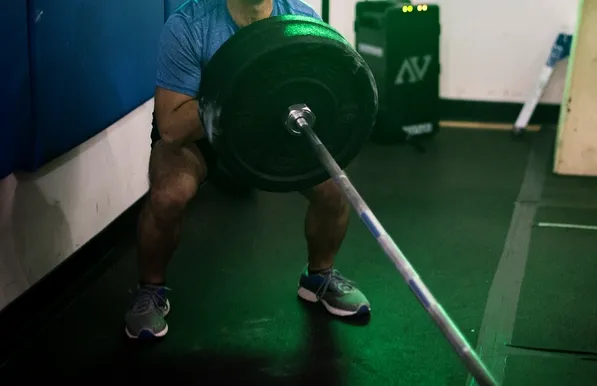
Landmine Squat: Form, 8 Variations & Muscles Worked
Landmine Squat: How to Do It, Variations & Muscles Worked
The landmine squat is a squat loaded by a barbell anchored at one end, so the weight travels along a fixed arc instead of a straight vertical line. That arc keeps your torso upright and drives your hips back. That is why we program it for tactical athletes who need hard leg strength when back squatting is limited by mobility, a cranky back, or a week stacked with load carriage. It is a staple in the tactical fitness training programs we build for service members, law enforcement, and first responders.
This guide covers what the landmine squat is, the muscles it trains, setup and form, eight variations, the squat-to-press, and the gear you need (or don’t). It also covers the loading quirk most guides skip: the bar never delivers its full weight to your hands.
Key Takeaways:
The landmine squat loads the squat pattern along a fixed arc, keeping the torso upright and limiting the forward lean that drives spinal loading in a back squat.
Quads and glutes do the primary work. Compared with a goblet squat, research shows less quad activity and more backward, hip-directed force.
You need a barbell and a landmine or a padded corner. Nothing else.
Your hands carry only part of the bar’s load, and that share changes with bar angle, so track plates on a consistent setup instead of converting to back squat numbers.
Run 3 to 5 sets of 5 to 12 reps, as a primary squat on limited-back days or as an accessory after heavier work.
What Is a Landmine Squat?
A landmine squat is a front-loaded squat in which one end of a barbell sits in a pivoting landmine base or a floor corner while you hold the loaded end at your chest. The bar moves through an arc as you descend and stand, guiding your torso upright and your hips back.
You will also see it called the landmine back squat or simply the landmine squat exercise, though the bar never rests on your back. Strength coach Ben Bruno is widely credited with bringing it into mainstream gyms (Seedman). The appeal is that it trains the same squat pattern as a barbell back squat, with a different force direction and almost no setup.
That force direction is the whole point. In a free-weight squat, gravity pulls straight down. On a landmine, the load travels along the bar’s arc toward the anchor, so part of the force pushes you back into your hips and heels. Per research in the Journal of Strength and Conditioning Research, the landmine squat produced greater backward horizontal ground reaction force than a goblet squat at the same load (Collins et al., 2021).
What Muscles Does the Landmine Squat Work?
The landmine squat works the quadriceps and glutes as prime movers, with the adductors and hamstrings assisting at the hip. Your core, upper back, and shoulders work isometrically to pin the bar to your chest and stop your torso from folding under load.
Quadriceps: extend the knee out of the bottom position and do most of the work through the middle of the rep.
Glutes: extend the hip to finish the rep. The arc pushes you back, which loads the hips earlier.
Adductors: stabilize the knees and hips, and work harder in wide stances like the sumo and cossack variations.
Hamstrings: co-contract to stabilize the knee and hip rather than acting as prime movers.
Core and upper back: brace against flexion so force transfers from the legs into the bar (McGill, 2016).
So why does the landmine squat work the glutes well? The arc forces you to sit back between your hips instead of driving the knees forward. In the Collins study, the landmine squat reduced vastus medialis and vastus lateralis activity compared with a goblet squat at matched loads (Collins et al., 2021). Translation: if you want a quad-dominant squat, the goblet or front squat does more. If you want a hip-biased squat that still trains the knees, the landmine squat fits better. Each lift has a job.
Why the Landmine Squat Works for Tactical Athletes
The landmine squat lets you train hard, high-quality squat volume with an upright torso and minimal equipment. For a tactical athlete, that means leg strength keeps building through a back flare-up, a shoulder that won’t tolerate a bar on the traps, or a week of rucks and pack runs that already taxed the spine.
Landmine Squat vs Back Squat
The back squat is still the better tool for maximal lower-body strength, because it lets you move the most absolute load. The cost is position. The bar on your traps demands shoulder mobility, and heavier loads drive more forward trunk lean, which raises shear and compressive demand on the lumbar spine (Schoenfeld, 2010). Front-loaded squats keep the torso more vertical and produced similar muscle recruitment with lower compressive knee forces than the back squat (Gullett et al., 2009).
The landmine squat sits at the far end of that spectrum: the most upright torso, the lowest spinal demand, and the lowest absolute load. Physical therapists and coaches have used it for years as a back-friendly squat for lifters who can’t yet squat a barbell pain-free (Training & Conditioning, 2017).
Why Load Management Matters on the Job
Musculoskeletal injuries are the leading cause of lost training and duty time across the Army, and they carry a strategic readiness cost (Molloy et al., 2020). The Army’s Holistic Health and Fitness doctrine treats strength training and injury reduction as part of the same system (FM 7-22, 2020). Load management isn’t soft. It is how you stay healthy long enough to get strong.
That trade-off sits at the core of functional strength for military performance: build capacity that transfers to the job without burning out the structures the job already loads. The landmine squat also scales from a new lifter learning to sit between the hips to a strong operator running heavy sets. And it travels, because a bar and a corner exist in almost every field gym, fire station, and garage. If you are deciding how lifts like this fit into a plan that also builds your engine, start with choosing a strength & endurance program.
How to Do a Landmine Squat: Setup and Form
Anchor the bar. Seat one end in a landmine base, or wedge it into a corner padded with a towel. Load plates on the free end and collar them.
Lift the bar. Squat down, grab the sleeve with both hands, and stand it up to chest height.
Set the hold. Cup the end of the sleeve with interlaced fingers, elbows under the bar, sleeve resting on the top of your sternum.
Set your stance. Face the anchor, feet about shoulder-width, toes turned out slightly. Stand far enough back that you lean lightly into the bar.
Brace and descend. Breathe into your belly, brace, and sit down between your hips, letting the arc guide them back. Keep your elbows inside your knees at the bottom.
Drive up. Push the floor away through the whole foot and stand tall, locking out hips and knees together.
Bracing before each rep matters because intra-abdominal pressure stiffens the trunk and protects the spine under load (Haff & Triplett, 2016). To do a landmine squat at home, use the same steps with the bar in a padded corner.
Common Landmine Squat Mistakes
Standing too close: the bar turns near-vertical, gets lighter, and slides off your chest.
Standing too far back: the bar pulls you forward and your lower back takes over the lift.
Letting the bar drift off the sternum: the load moves away from your center of mass and your upper back rounds.
Cutting depth: partial reps leave strength on the table. Deep squats with sound technique are not inherently harmful to the knees or spine (Hartmann et al., 2013; Escamilla, 2001).
Rushing the descent: the arc rewards a controlled lowering phase, so own the bottom instead of bouncing out of it.
Landmine Squat Variations
The landmine squat variations below change your stance, your hold, or how many legs share the load. Each has a specific job.
Landmine Hack Squat
Face away from the anchor with the sleeve resting on your shoulders, usually through a hack squat handle, and set your feet slightly forward. Lean back into the bar as you squat. Best use: quad-biased work that feels like a machine hack squat without the machine.
Landmine Goblet Squat
This is the default version: both hands cupping the sleeve at your chest. Best use: learning the pattern, high-rep work, and any day the back needs a break.
Landmine Front Squat
Hold the sleeve in one hand at the front of the shoulder, elbow high, and squat. The offset load forces your trunk to resist rotation and side bend. Best use: building trunk stability that carries over to uneven loads like casualty drags and kit.
Landmine Sumo Squat
Straddle the bar with a wide stance, toes out, and hold the sleeve with straight arms between your legs. Squat down and stand. Best use: adductor and glute strength with almost no load on the shoulders.
Landmine Split Squat
Take a staggered stance with the sleeve at your chest or in the hand on the rear-leg side, and drop the back knee toward the floor. It trains the same single-leg strength as the Bulgarian split squat, with a more guided bar path. Best use: unilateral strength and fixing side-to-side gaps.
Landmine Cossack Squat
From a wide stance, shift into one leg while the other stays straight, toes up. The sleeve at your chest counterbalances you. Best use: frontal-plane hip mobility and adductor strength.
Landmine Lateral Squat
A shorter-range cousin of the cossack: step or shift sideways into one hip and push back to center, the same pattern as a lateral lunge. Best use: lateral strength for cutting, climbing, and stepping over obstacles.
Single-Leg Landmine Squat
Squat on one leg (pistol or skater style) while holding the sleeve. The anchored bar helps you balance. Best use: single-leg control for rough terrain and stairs under load.
How Does the Landmine Squat Compare to the Goblet and Zercher Squat?
The landmine squat, goblet squat, and zercher squat all keep the load in front of you, which keeps the torso upright and makes the trunk work. They differ in load ceiling and bar path. The goblet squat uses a dumbbell or kettlebell at the chest and produced more quad activity and vertical force than the landmine squat at matched loads (Collins et al., 2021). The zercher squat holds a barbell in the crook of the elbows, which allows far heavier loading and taxes the upper back, at a real cost in comfort.
Use the goblet squat to teach the pattern, the zercher squat when you need heavy front loading, and the landmine squat when spinal load is the limiting factor.
How to Do a Landmine Squat-to-Press
The landmine squat-to-press is a full-body variation where you drive out of the bottom of a landmine squat and carry that momentum into pressing the bar up and away along its arc. It links leg drive to the shoulders through a braced trunk, the same chain you use to push a load overhead or drive through resistance.
Set up exactly as for a landmine goblet squat.
Squat to full depth with the sleeve on your sternum.
Drive up hard, and as your hips reach extension, press the bar up and forward until your arms lock out.
Lower the sleeve to your chest under control, then start the next squat.
A landmine sumo squat to press uses the same sequence from a wide stance, which shifts more work into the adductors. The angled press path also tends to sit more comfortably on the shoulders than a strict overhead press, because the bar travels in front of the head. For power, run 3 to 5 sets of 3 to 6 reps and stop each set when bar speed drops.
Landmine Attachments: Do You Need One for the Landmine Squat?
No. A padded corner trains the same movement. A landmine attachment makes setup faster, protects walls and floors, and lets the anchor pivot freely, which smooths out the arc.
Rack-mounted attachment: a pivoting sleeve that fits a squat rack with landmine attachment holes or a post. The most common gym setup.
Floor base: a standalone plate or frame that holds the bar end anywhere in the room.
Corner: wedge the bar into a corner wrapped in a towel, and check that it can’t slide under load.
Hack squat attachment: a yoke or handle that slides onto the sleeve so the bar rests on your shoulders for the landmine hack squat.
Belt squat setup: for a landmine belt squat, a dip belt hangs from the sleeve and the load sits at your hips. It removes the spine from the chain almost entirely, which makes it a useful tool during back rehab.
How to Program the Landmine Squat
How to Calculate Weight for a Landmine Squat
You cannot read the load off the plates. The anchor supports one end of the bar, so your hands carry only part of the system’s weight, and that share changes with bar angle and where the plates sit on the sleeve.
The bar works as a lever pivoting at the anchor. The bar’s own weight acts at its midpoint, so it contributes roughly half to the load at your hands. Plates sit close to your hands, so they contribute most of theirs. As the bar rises toward vertical, more weight shifts onto the anchor, which is why the bottom of a landmine squat feels heaviest and the top feels lightest. In a standard lever model, a 20 kg bar with 40 kg of plates held at a 45-degree angle delivers about 35 kg of force at the hands, even though the system weighs 60 kg (Calculator Academy, based on Zhao et al., 2026).
So what is the equivalent weight for a landmine squat? There is no reliable conversion to back squat or goblet squat numbers, because bar angle depends on your height, arm length, and stance. A taller lifter holds the bar steeper and feels less load than a shorter teammate with identical plates. Track it simply: log the bar, the plates, and your foot position, then progress by adding plates to that same setup.
Landmine Squat Sets, Reps, and Placement
For strength, run 3 to 5 sets of 5 to 8 reps. For muscle and work capacity, run 3 to 4 sets of 8 to 12 reps. Both strength and hypertrophy develop across a wide rep range when sets are taken close to failure (Schoenfeld et al., 2021), so match the range to your training block.
Primary squat: on days when spinal loading is off the table, such as the day after a long ruck, during a back flare-up, or in a deload week.
Accessory: 2 to 3 sets of 10 to 12 after a heavier back or front squat.
Power slot: the squat-to-press early in the session, 3 to 5 sets of 3 to 6.
Field-gym leg day: landmine squat, a split squat variation, and loaded carries.
For how a squat variation fits into the rest of a training week, the structure of a strength workout for athletes lays out where each lift belongs.
FAQ: Frequently Asked Questions
What is a landmine squat and what does it work?
A landmine squat is a squat in which you hold one end of a barbell at your chest while the other end is anchored in a landmine or corner. The bar follows a fixed arc. It trains the quads and glutes as prime movers, with the adductors and hamstrings assisting, while the core and upper back brace to hold the bar in place.
What are the main landmine squat variations?
The main landmine squat variations are the hack, goblet, front, sumo, split, cossack, lateral, and single-leg squat, plus the squat-to-press. The goblet version is the default. The hack squat biases the quads, the sumo and cossack target the adductors, and the split and single-leg versions build unilateral strength.
Is the landmine squat easier on the back than a back squat?
Yes, for most lifters. The landmine squat keeps your torso more upright and uses a lower absolute load, which reduces compressive and shear demand on the lumbar spine compared with a heavy back squat. That makes it a strong option during back flare-ups or heavy load-carriage weeks, though it won’t build maximal strength as well as the back squat.
What is a landmine squat-to-press?
A landmine squat-to-press is a full-body variation where you squat with the bar at your chest, then use your leg drive to press the bar up and forward along its arc until your arms lock out. It builds power through the legs, trunk, and shoulders in one movement. Program it for low reps, 3 to 6 per set, with crisp bar speed.
How do you calculate the weight on a landmine squat?
You can’t use the plate total. Your hands carry roughly half the bar’s weight plus most of the plate weight, and the share drops as the bar rises toward vertical. Because the angle depends on your height and stance, there is no reliable back squat conversion. Log the bar, plates, and foot position, and progress by adding plates to the same setup.
Do you need a landmine attachment, or can you use a corner?
A corner works fine. Wedge the bar into a corner padded with a towel and confirm it can’t slide. A landmine attachment adds speed, a smoother pivot, and protection for walls and floors, and specialty handles open up the hack squat and belt squat variations, but the basic landmine squat needs nothing more than a barbell and a corner.
The landmine squat solves a real problem for tactical athletes: building quad and glute strength when your spine, shoulders, or schedule can’t absorb another heavy back squat. Set it up right, pick the variation that matches the job, and track it by plates on a consistent setup instead of chasing back squat conversions. Then put it inside a plan. Start a program that slots the landmine squat around your rucks, runs, and test dates, so every leg session moves you toward the standard you’re training for.
References:
Collins KS, Klawitter LA, Waldera RW, Mahoney SJ, Christensen BK. Differences in muscle activity and kinetics between the goblet squat and landmine squat in men and women. Journal of Strength and Conditioning Research. 2021;35(10):2661-2668.
Schoenfeld BJ. Squatting kinematics and kinetics and their application to exercise performance. Journal of Strength and Conditioning Research. 2010;24(12):3497-3506.
Gullett JC, Tillman MD, Gutierrez GM, Chow JW. A biomechanical comparison of back and front squats in healthy trained individuals. Journal of Strength and Conditioning Research. 2009;23(1):284-292.
Escamilla RF. Knee biomechanics of the dynamic squat exercise. Medicine and Science in Sports and Exercise. 2001;33(1):127-141.
Hartmann H, Wirth K, Klusemann M. Analysis of the load on the knee joint and vertebral column with changes in squatting depth and weight load. Sports Medicine. 2013;43(10):993-1008.
Schoenfeld BJ, Grgic J, Van Every DW, Plotkin DL. Loading recommendations for muscle strength, hypertrophy, and local endurance: a re-examination of the repetition continuum. Sports. 2021;9(2):32.
McGill S. Low Back Disorders: Evidence-Based Prevention and Rehabilitation. 3rd ed. Human Kinetics; 2016.
Haff GG, Triplett NT, eds. Essentials of Strength Training and Conditioning. 4th ed. National Strength and Conditioning Association, Human Kinetics; 2016.
Molloy JM, Pendergrass TL, Lee IE, et al. Musculoskeletal injuries and United States Army readiness part I: overview of injuries and their strategic impact. Military Medicine. 2020;185(9-10):e1461-e1471.
Headquarters, Department of the Army. FM 7-22, Holistic Health and Fitness. October 2020.
Disclaimer: This article is for educational purposes only and is not medical advice. Consult a qualified healthcare provider before starting a new training program, especially if you have a current or past injury, back pain, or a medical condition. Stop any exercise that causes sharp or worsening pain. Individual results vary with training history, recovery, and consistency.


