
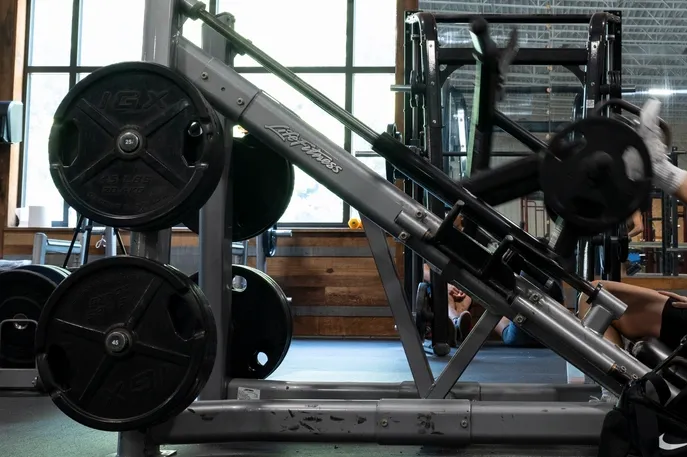
Hack Squat Alternative: 8 Quad Builders | Combat Fitness
Hack Squat Alternatives: The Best Quad-Building Substitutes (No Machine Needed)
The best hack squat alternative is the front squat if you have a barbell, and the heels-elevated goblet squat if you don’t. Both keep what makes the hack squat worth doing: an upright torso, a deep knee bend, and a load that lands on the quads. We program lower-body strength for service members and first responders who train in garages, unit gyms, and hotel rooms, so the hack squat machine is usually the first thing missing. If you want the swap built into a complete plan, our tactical fitness programs handle that for you.
Below are eight substitutes ranked by how well they replicate the quad stimulus. We also cover no-machine and at-home options, reverse hack squat swaps for glutes, and how to program the change so you don’t lose progress.
Why Look for a Hack Squat Alternative?
A hack squat alternative has to do what the machine does: load the quads through a deep range while your torso stays upright. The sled locks you onto an angled track, so balance and spinal position mostly drop out and the knee extensors do the work. That is why the hack squat builds quads efficiently. It is also why a back squat with a heavy forward lean is a poor replacement, since a forward lean shifts the load toward the hips.
People look for an alternative to the hack squat for three reasons:
No machine. The gym, station, or garage doesn’t have one.
Joint comfort. The fixed track doesn’t suit everyone’s knees or hips.
Variety. Months on one pattern stall progress and invite overuse.
For tactical athletes, the first reason dominates. Quad strength still decides how you climb stairs under SCBA, drag a casualty, and absorb a ruck descent. Quad and knee durability sit at the center of functional strength for military performance, so the substitute must build the same capacity with whatever equipment you have. Resistance training is also one of the best-supported tools for reducing sports injuries, which makes it a readiness issue, not only a physique one.
How We Ranked These Hack Squat Substitutes
We scored every alternative exercise to the hack squat on four criteria:
Knee travel and depth: how far the knee bends and moves forward under load.
Torso angle: a more upright torso puts more of the work on the quads.
Loadability: whether you can keep progressing it for months.
Equipment: barbell, dumbbell, bodyweight, cable, or machine.
The best hack squat alternatives, in order: front squat, heels-elevated goblet or front squat, goblet squat, leg press, Bulgarian split squat, belt squat, landmine hack squat, and sissy squat.
If you are still deciding on the larger plan these swaps fit inside, the guide to choosing a strength & endurance program covers how to balance lifting against conditioning.
1. Front Squat (Best Barbell Hack Squat Alternative)
The front squat is the best barbell hack squat alternative. Racking the bar on your front delts forces an upright torso, which shifts the work toward the quads. A biomechanics study in the Journal of Strength and Conditioning Research found front and back squats recruited the legs similarly, with lower compressive forces at the knee in the front squat.
How to do it: clean grip or cross-arm rack, elbows high, sit straight down between your heels, and drive up without letting your chest drop.
Verdict: the closest strength-building match if you own a barbell and a rack.
2. Heels-Elevated Goblet or Front Squat (Closest Free-Weight Match)
Raising your heels on a slant board or 1 to 2 inches of plates lets the knees travel farther forward while the torso stays tall. Research on weightlifting shoes and heel wedges shows the same effect: more knee flexion and a more upright trunk. That is the hack squat’s signature position, rebuilt with free weights.
How to do it: heels on the wedge, feet about hip-width, a dumbbell at your chest or a barbell in the front rack, and squat until your hamstrings meet your calves.
Verdict: the closest free-weight replica of the machine.
3. Goblet Squat (Best Dumbbell Starting Point)
The goblet squat is the most practical hack squat alternative with dumbbells. Holding one bell at your chest counterbalances the descent, so you can sit deep and upright without a rack. It also teaches the front-squat position, which makes it the right entry point for newer lifters.
Facing a low cable pulley with a rope or handle at your chest turns it into the best cable hack squat alternative, because the cable keeps tension on the quads near lockout.
Verdict: start here, then move to the heels-elevated or front squat once your heaviest dumbbell gets easy.
4. Leg Press (Best Machine Swap)
The leg press keeps the supported back and fixed path, which makes it the most direct machine substitute. Foot position decides the emphasis. A low, narrow stance increases knee bend and quad demand, while a high, wide stance shifts work toward the hips.
Trade-off: most people get less range on the leg press than on the hack squat. Go as deep as you can while your lower back stays on the pad. A Smith machine squat with feet slightly forward works the same way if there is no leg press.
Verdict: the best option in a commercial gym that has machines but no hack squat.
5. Bulgarian Split Squat (Best Single-Leg Option)
The Bulgarian split squat trains one leg at a time with the rear foot elevated. That loads the front quad hard and exposes side-to-side imbalances a bilateral lift hides. EMG research shows high quad and glute activation across split squat variations. A short stance with the front knee traveling forward biases the quads; a long stance with a forward lean biases the glutes.
Verdict: the best single-leg substitute and the most specific to stepping, climbing, and moving under load over uneven ground.
6. Belt Squat (Best for a Cranky Back)
The belt squat hangs the load from a hip belt, so your spine carries nothing. That makes it the right choice when your back is beat up from rucking or heavy carries but your legs still need work. You can stand tall and let the knees travel forward, which keeps it quad-dominant.
No belt squat machine? Stand on two boxes with a dip belt and a kettlebell hanging between them.
Verdict: the best hack squat substitute when spinal loading is the limiter.
7. Landmine Hack Squat (Closest Feel to the Sled)
Anchor a barbell in a landmine, hold the sleeve at your chest or across your shoulders, and lean back into the bar with your feet slightly forward. The arc of the bar mimics the angled track of a hack squat sled, and your heels stay planted while your knees drive forward.
Verdict: the closest landmine hack squat alternative to the machine itself, with nothing more than a barbell and a corner or landmine attachment.
8. Sissy Squat (Best No-Equipment Quad Finisher)
The sissy squat uses bodyweight only. You rise onto the balls of your feet, lean back, and let the knees travel far forward while your hips stay extended. That loads the quads at long muscle lengths, which recent research links to strong hypertrophy gains. Hold a post or doorframe for balance and use a partial range until your knees adapt.
Verdict: a finisher, not a main lift, and not the right pick if your knees are already irritated.
No-Machine and At-Home Hack Squat Alternatives
The best no-machine hack squat alternative at home is the heels-elevated squat: put your heels on a plate, book, or slant board and squat deep with your chest up. Going without equipment changes the loading tool, not the pattern. Scale by what you own:
No equipment: heels-elevated bodyweight squat with a slow lowering, split squat, sissy squat.
Dumbbells or kettlebells: goblet squat, heels-elevated goblet squat, Bulgarian split squat.
Home gym with a barbell: front squat, landmine hack squat.
Commercial gym without free barbells (the setup at many Planet Fitness locations): leg press or a feet-forward Smith machine squat.
A Hack Squat Alternative Workout at Home
Heels-elevated goblet squat: 4 sets of 8 to 12, 3-second lowering
Bulgarian split squat: 3 sets of 8 to 10 per leg
Sissy squat: 2 sets of 10 to 15
Rest 90 seconds to 2 minutes and stop each set 1 to 3 reps short of failure. Light loads build muscle when sets are taken close to failure, which is why a slow, hard bodyweight set still counts.
Reverse Hack Squat Alternatives for Glutes (and the Best Swaps for Quads)
The reverse hack squat has you facing the pad, which pushes the hips back and shifts the emphasis toward the glutes. The best reverse hack squat alternative for glutes is a hip extension movement, not another upright squat:
Barbell hip thrust: a 2015 EMG study found higher glute activation in the hip thrust than in the back squat.
Romanian deadlift: loads the glutes and hamstrings at long muscle lengths.
Long-stance Bulgarian split squat or deficit reverse lunge with a slight forward lean.
For the standard hack squat’s quad emphasis, the best alternative to the hack squat for quads is the heels-elevated front or goblet squat, followed by a sissy squat finisher. For a single-leg hack squat alternative, use a heels-elevated split squat, a single-leg leg press, or a high step-up with the knee driving forward over the toes.
How to Program the Swap: Sets, Reps, and Load
Replace the hack squat by keeping the slot, rep range, and effort the same. The exercise changes; the training effect shouldn’t.
Keep the slot. If the hack squat opened your leg day, the front squat or heels-elevated goblet squat opens it now.
Match reps to the goal. Use 3 to 6 reps for strength on barbell options and 8 to 15 for hypertrophy on dumbbell, single-leg, and bodyweight options.
Match effort. Finish most sets with 1 to 3 reps in reserve.
Hold weekly volume. Research on training volume supports roughly 10 or more hard sets per muscle per week for growth.
Progress one variable at a time. Add reps first, then load, then slow the tempo.
Give it four to six weeks before judging the swap.
To see how the substitution fits a full training week, use our template for a strength workout for athletes.
A note on knees: muscular burn is expected, sharp joint pain is not. If a variation causes pain, reduce depth or switch to the belt squat or leg press, and see a physical therapist or sports medicine physician before pushing through it.
FAQ: Frequently Asked Questions
What is the best alternative to the hack squat?
The front squat is the best alternative to the hack squat for most athletes with a barbell. It keeps the torso upright and the quads loaded through a deep range. Without a barbell, the heels-elevated goblet squat is the closest match, because raising the heels lets the knees travel forward the way the sled does.
What can I do instead of a hack squat at home?
At home, do heels-elevated squats, split squats, and sissy squats. Add a dumbbell or kettlebell held at the chest when you have one. Use a slow 3-second lowering and take sets close to failure, since effort drives the training effect when load is limited.
What is a good dumbbell or barbell hack squat alternative?
The best dumbbell option is the heels-elevated goblet squat. The best barbell option is the front squat, with the landmine hack squat as the closest feel to the machine. Both barbell versions let you progress load for months.
Which hack squat alternative is best for quads?
The heels-elevated front squat or goblet squat is best for quads because it combines deep knee bend with an upright torso. Add sissy squats as a finisher to load the quads at long muscle lengths, which research links to strong hypertrophy.
Leg press vs. hack squat: are they interchangeable?
The leg press and hack squat are close enough to swap for quad training. Both use a supported back and a fixed path. The leg press usually allows less depth, so use a low, narrow foot position to keep the emphasis on the quads.
Do the alternatives build the same muscles as the hack squat?
Yes. Every alternative here trains the quads as the primary mover, with the glutes and adductors assisting. Free-weight and single-leg versions add trunk and balance demand the machine removes. Depth matters too: deeper squats build more glute and adductor muscle than shallow ones.
The right hack squat alternative is the one that keeps your knees bending deep and your torso upright under load you can progress. Front squats and heels-elevated goblet squats cover most athletes, and the rest of this list fills the gaps for home training, sore backs, and single-leg work. Knowing the swap is the easy part; running it inside a plan that also handles your conditioning and recovery is what keeps the quad strength you build. Start a structured lower-body block with CF ONE and train it with a purpose.
References:
Gullett JC, Tillman MD, Gutierrez GM, Chow JW. A biomechanical comparison of back and front squats in healthy trained individuals. Journal of Strength and Conditioning Research. 2009;23(1):284-292.
Escamilla RF. Knee biomechanics of the dynamic squat exercise. Medicine and Science in Sports and Exercise. 2001;33(1):127-139.
Escamilla RF, Fleisig GS, Zheng N, Barrentine SW, Wilk KE, Andrews JR. Biomechanics of the knee during closed kinetic chain and open kinetic chain exercises. Medicine and Science in Sports and Exercise. 1998;30(4):556-569.
Schoenfeld BJ. Squatting kinematics and kinetics and their application to exercise performance. Journal of Strength and Conditioning Research. 2010;24(12):3497-3506.
Clark DR, Lambert MI, Hunter AM. Muscle activation in the loaded free barbell squat: a brief review. Journal of Strength and Conditioning Research. 2012;26(4):1169-1178.
Hartmann H, Wirth K, Klusemann M. Analysis of the load on the knee joint and vertebral column with changes in squatting depth and weight load. Sports Medicine. 2013;43(10):993-1008.
Sato K, Fortenbaugh D, Hydock DS. Kinematic changes using weightlifting shoes on barbell back squat. Journal of Strength and Conditioning Research. 2012;26(1):28-33.
Charlton JM, Hammond CA, Cochrane CK, Hatfield GL, Hunt MA. The effects of a heel wedge on hip, pelvis and trunk biomechanics during squatting in resistance trained individuals. Journal of Strength and Conditioning Research. 2017;31(6):1678-1687.
Da Silva EM, Brentano MA, Cadore EL, De Almeida AP, Kruel LF. Analysis of muscle activation during different leg press exercises at submaximum effort levels. Journal of Strength and Conditioning Research. 2008;22(4):1059-1065.
Mausehund L, Skard AE, Krosshaug T. Muscle activation in unilateral barbell exercises: implications for strength training and rehabilitation. Journal of Strength and Conditioning Research. 2019;33(Suppl 1):S85-S94.
Speirs DE, Bennett MA, Finn CV, Turner AP. Unilateral vs. bilateral squat training for strength, sprints, and agility in academy rugby players. Journal of Strength and Conditioning Research. 2016;30(2):386-392.
Contreras B, Vigotsky AD, Schoenfeld BJ, Beardsley C, Cronin J. A comparison of gluteus maximus, biceps femoris, and vastus lateralis EMG activity in the back squat and barbell hip thrust exercises. Journal of Applied Biomechanics. 2015;31(6):452-458.
Kubo K, Ikebukuro T, Yata H. Effects of squat training with different depths on lower limb muscle volumes. European Journal of Applied Physiology. 2019;119(9):1933-1942.
Pedrosa GF, Lima FV, Schoenfeld BJ, et al. Partial range of motion training elicits favorable improvements in muscular adaptations when carried out at long muscle lengths. European Journal of Sport Science. 2022;22(8):1250-1260.
Schoenfeld BJ, Ogborn D, Krieger JW. Dose-response relationship between weekly resistance training volume and increases in muscle mass: a systematic review and meta-analysis. Journal of Sports Sciences. 2017;35(11):1073-1082.
Schoenfeld BJ, Grgic J, Ogborn D, Krieger JW. Strength and hypertrophy adaptations between low- vs. high-load resistance training: a systematic review and meta-analysis. Journal of Strength and Conditioning Research. 2017;31(12):3508-3523.
Helms ER, Cronin J, Storey A, Zourdos MC. Application of the repetitions in reserve-based rating of perceived exertion scale for resistance training. Strength and Conditioning Journal. 2016;38(4):42-49.
Schoenfeld BJ, Pope ZK, Benik FM, et al. Longer interset rest periods enhance muscle strength and hypertrophy in resistance-trained men. Journal of Strength and Conditioning Research. 2016;30(7):1805-1812.
Plotkin D, Coleman M, Van Every D, et al. Progressive overload without progressing load? The effects of load or repetition progression on muscular adaptations. PeerJ. 2022;10:e14142.
American College of Sports Medicine. Progression models in resistance training for healthy adults. Medicine and Science in Sports and Exercise. 2009;41(3):687-708.
Lauersen JB, Bertelsen DM, Andersen LB. The effectiveness of exercise interventions to prevent sports injuries: a systematic review and meta-analysis of randomised controlled trials. British Journal of Sports Medicine. 2014;48(11):871-877.
Headquarters, Department of the Army. FM 7-22, Holistic Health and Fitness. Washington, DC; 2020.
Disclaimer: This article is for educational purposes and is not medical advice. Consult a qualified healthcare provider before starting a new training program, especially if you have a current or past knee, hip, or back injury. Stop any exercise that causes sharp or worsening joint pain.


