
Cross-Body Hammer Curl: Form & Muscles | Combat Fitness
Cross-Body Hammer Curl: How to Do It, Muscles Worked & Benefits
The cross-body hammer curl is a neutral-grip dumbbell curl that travels across your torso toward the opposite shoulder instead of straight up beside your hip. That change in path puts more of the load on the brachialis and brachioradialis, the elbow flexors that hold a rope, carry a kettlebell, and drag a casualty. We use it inside our military fitness programs for elbow and grip durability, not arm size.
Below you get the full picture: what the movement is, the muscles it trains, how it compares with the regular hammer curl, clean form, and how to program it without wasting training time.
What Is a Cross-Body Hammer Curl?
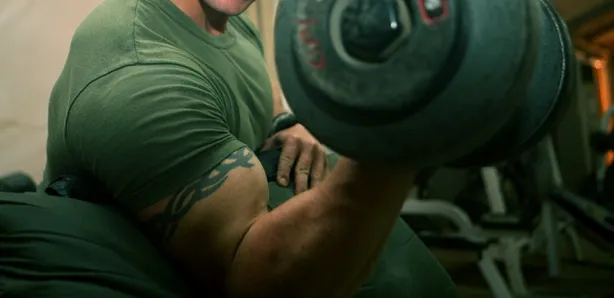
A cross-body hammer curl is an elbow-flexion exercise where you hold a dumbbell with a neutral grip (palm facing your body) and curl it diagonally across your chest toward the opposite shoulder or pec. You will also see it written as a crossbody hammer curl, a cross body curl, or a hammer curl cross body. All of those describe the same movement.
The grip is identical to the standard hammer curl. What changes is the path. Instead of the forearm staying in line with your torso, the upper arm stays pinned to your side while the hand travels inward. We cover the fundamentals of the straight-path version in our hammer curl guide, so this post focuses on what the across-body path adds and when it earns a spot in your training.
What Muscles Does the Cross-Body Hammer Curl Work?
The cross-body hammer curl primarily targets the brachialis, with heavy involvement from the brachioradialis in the forearm and supporting work from the biceps brachii. The neutral grip is what drives this mix. It reduces the biceps’ advantage as a supinator and shifts more demand onto the other two elbow flexors.
Brachialis
The brachialis sits under the biceps on the front of the upper arm and attaches to the ulna. Because it does not cross the shoulder and does not rotate the forearm, it is a pure elbow flexor that works in every grip position (Plantz and Bordoni). Training it builds thickness on the outer arm and, more usefully, raw pulling capacity at the elbow.
Brachioradialis
The brachioradialis runs from the lower humerus to the wrist on the thumb side of the forearm. It produces its strongest flexion with the forearm in a neutral position, which is exactly where the hammer grip puts it (Boland et al.). This is the muscle you feel working on long carries and rope work.
Biceps brachii
The biceps still contributes, but less than in a supinated curl. Electromyography research shows biceps activity drops as the hand moves away from a palm-up position, while brachioradialis activity rises (Kleiber et al.). That trade is the point of the exercise.
Cross-Body Hammer Curl vs. Regular Hammer Curl: What’s the Difference?
The cross-body hammer curl and the regular hammer curl use the same neutral grip and train the same three muscles. The difference is the path. The regular version curls straight up beside the body, while the cross-body version curls diagonally to the opposite shoulder, which changes the line of pull and tends to bias the brachialis harder.
Here is how the two compare on the factors that matter:
Path: the regular hammer curl travels in a straight line beside your hip. The cross-body version travels inward across your chest.
Muscle emphasis: both load the brachialis and brachioradialis. Lifters and coaches consistently report a stronger brachialis contraction on the cross-body path, though direct EMG comparisons between the two variations are limited, so treat that as a practical bias rather than a proven gap.
Load: most athletes handle slightly less weight across the body because the path is longer and harder to cheat.
Cheating risk: the cross-body path makes it harder to swing the weight with the hips, which keeps tension on the elbow flexors.
Best use: the regular hammer curl is the better strength builder for heavier loads. The cross-body version is the better finisher for brachialis volume and elbow durability.
Which should you pick? If you only have room for one arm movement, the regular hammer curl lets you load heavier and progress faster. If you already train hammer curls and want more elbow-flexor resilience for rope climbs, pull-ups under kit, and carries, rotate the cross-body version in for a training block.
How to Do a Cross-Body Hammer Curl With Proper Form
Clean form keeps the work on the elbow flexors and off your lower back and shoulder. Follow these steps:
Stand tall with a dumbbell in each hand, arms straight, palms facing your thighs.
Brace your trunk and pin your upper arm against your side. The elbow stays put for the entire rep.
Curl one dumbbell up and across your body toward the opposite pec or shoulder, keeping the neutral grip the whole way.
Pause for a one-count squeeze at the top, with the dumbbell just below the opposite collarbone.
Lower under control over two to three seconds along the same diagonal path until the arm is fully straight.
Alternate arms, or finish all reps on one side before switching.
Full extension at the bottom matters. Training elbow flexors through a complete range of motion has produced better strength and muscle-thickness gains than partial reps in controlled studies (Pinto et al.), and the stretched position does a large share of the work (Pedrosa et al.).
Common mistakes
Swinging the weight: hip drive moves the load off the arm. Drop the weight until your torso stays still.
Going too wide: curling past the midline toward the far shoulder rolls the shoulder forward. Stop at the opposite pec.
Losing the grip: letting the palm rotate up turns it into a cross-body biceps curl. Keep the thumb pointed up.
Skipping the lowering phase: dropping the dumbbell removes half the training stimulus. Own the descent.
Cross-Body Hammer Curl Programming and Variations
The cross-body hammer curl is an accessory lift. It belongs after your main compound work, not in place of it. Pulling, carrying, and hinging still build the bulk of your occupational strength, and arm isolation fills the gaps they leave.
Sets and reps
For most tactical athletes, 2 to 4 sets of 8 to 15 reps per arm, once or twice a week, is enough. Muscle growth occurs across a wide range of loads when sets are taken close to failure (Schoenfeld et al., 2021), and total weekly sets drive results more than any single rep scheme (Schoenfeld et al., 2017). Keep one or two reps in reserve so the elbows stay fresh for pull-ups and rope work later in the week.
Where it fits matters more than the rep count. Slot it at the end of an upper-body or pull session, the way we lay out accessory work in a strength workout for athletes. If you are still deciding how strength and conditioning should share your week, our guide to choosing a strength & endurance program covers how to weigh the options.
Variations
Dumbbell cross-body hammer curl: the standard version. Easy to load and progress.
Alternating cross-body hammer curl: one arm at a time, which gives each side a short rest and lets you focus on the squeeze.
Single-arm cross-body hammer curl: all reps on one side first. Useful for correcting a strength imbalance between arms.
Seated cross-body hammer curl: sitting on a bench removes hip drive entirely, which forces strict reps.
Cable cross-body hammer curl: a low pulley with a rope or single handle keeps tension constant through the full range, including the bottom where dumbbells go slack.
Frequently Asked Questions
What muscles does the cross-body hammer curl work?
The cross-body hammer curl works the brachialis most, followed by the brachioradialis in the forearm and the biceps brachii. The neutral grip reduces biceps involvement compared with a palm-up curl and shifts more load to the brachialis and brachioradialis. Your grip muscles and trunk stabilizers also work to hold the dumbbell steady.
Cross-body hammer curl vs. regular hammer curl: what’s the difference?
The difference is the path. A regular hammer curl moves straight up beside your body, while the cross-body version curls diagonally toward the opposite shoulder. Both use a neutral grip. The cross-body path is harder to cheat and tends to bias the brachialis, while the regular version usually allows heavier loads.
How do you do a cross-body hammer curl with proper form?
Stand tall, palms facing in, upper arm pinned to your side. Curl the dumbbell across your body toward the opposite pec, keeping the thumb up. Squeeze for a count at the top, then lower over two to three seconds to full extension. Keep your torso still and your elbow fixed throughout.
Is the cross-body hammer curl better for the brachialis?
The cross-body hammer curl is commonly used to bias the brachialis, and many lifters feel a stronger contraction there than in a standard hammer curl. Direct research comparing the two paths is limited, so the advantage is practical rather than proven. Either neutral-grip variation trains the brachialis well when taken close to failure.
Can you do cross-body hammer curls on a cable?
Yes. Set a low pulley, attach a rope or single handle, and curl across your body with a neutral grip. The cable keeps tension on the muscle at the bottom of the rep, where a dumbbell loses resistance. It works well as a higher-rep finisher after heavier dumbbell work.
How many reps and sets should you do?
Most athletes do well with 2 to 4 sets of 8 to 15 reps per arm, once or twice a week, finishing each set with one or two reps left in the tank. Treat it as an accessory after your main lifts. Add reps first, then weight, as the movement gets easier.
The cross-body hammer curl is a small lift with a specific job: building brachialis and forearm strength that holds up on ropes, carries, and long days under load. Keep the elbow pinned, curl to the opposite pec, own the lowering phase, and program it as an accessory after the work that matters most. If you want it placed inside a full plan that balances strength, conditioning, and recovery, start a Combat Fitness program and train with a structure built around the job you are preparing for.
References:
Plantz MA, Bordoni B. Anatomy, Shoulder and Upper Limb, Brachialis Muscle. StatPearls. Treasure Island (FL): StatPearls Publishing.
Boland MR, Spigelman T, Uhl TL. The function of brachioradialis. Journal of Hand Surgery (American Volume). 2008;33(10):1853-1859. doi:10.1016/j.jhsa.2008.07.019
Kleiber T, Kunz L, Disselhorst-Klug C. Muscular coordination of biceps brachii and brachioradialis in elbow flexion with respect to hand position. Frontiers in Physiology. 2015;6:215. doi:10.3389/fphys.2015.00215
Tiwana MS, Charlick M, Varacallo M. Anatomy, Shoulder and Upper Limb, Biceps Muscle. StatPearls. Treasure Island (FL): StatPearls Publishing.
Pinto RS, Gomes N, Radaelli R, Botton CE, Brown LE, Bottaro M. Effect of range of motion on muscle strength and thickness. Journal of Strength and Conditioning Research. 2012;26(8):2140-2145. doi:10.1519/JSC.0b013e31823a3b15
Pedrosa GF, Lima FV, Schoenfeld BJ, et al. Partial range of motion training elicits favorable improvements in muscular adaptations when carried out at long muscle lengths. European Journal of Sport Science. 2022;22(8):1250-1260.
Schoenfeld BJ, Ogborn D, Krieger JW. Dose-response relationship between weekly resistance training volume and increases in muscle mass: a systematic review and meta-analysis. Journal of Sports Sciences. 2017;35(11):1073-1082. doi:10.1080/02640414.2016.1210197
Schoenfeld BJ, Grgic J, Van Every DW, Plotkin DL. Loading recommendations for muscle strength, hypertrophy, and local endurance: a re-examination of the repetition continuum. Sports. 2021;9(2):32. doi:10.3390/sports9020032
American College of Sports Medicine. Progression models in resistance training for healthy adults. Medicine and Science in Sports and Exercise. 2009;41(3):687-708. doi:10.1249/MSS.0b013e3181915670
Headquarters, Department of the Army. FM 7-22, Holistic Health and Fitness. Washington, DC; 2020.
Disclaimer: This article is for educational purposes only and is not medical advice. Consult a qualified healthcare provider before starting a new training program, especially if you have an elbow, wrist, or shoulder injury. Results vary with training history, recovery, and consistency.


