Machines at the Gym for Chest: 5 to Use | Combat Fitness
Chest Machines at the Gym: Which Ones to Use and How to Build the Workout
Five machines at the gym for chest are worth your time: the chest press (flat and incline), the pec deck or fly machine, the cable crossover, the Smith machine, and the assisted or weighted dip machine. Each one has a different job. Presses build mass and pressing strength, and the fly machines train the chest in a deep stretch with the triceps taken out. Machines add volume, but they don’t replace your barbell and bodyweight pressing, and that’s how our military fitness programs use them.
We program for tactical athletes who train wherever they’re posted: a base gym, a big-box chain, a hotel. Below you’ll find what each chest machine trains, how to set it up, an honest comparison of machines and free weights, and a ready-to-run machine chest workout.
Key Takeaways:
The chest press machine is the workhorse. Use flat for overall mass and incline (about 30 degrees) for the upper chest.
The pec deck trains the chest in a loaded stretch with no triceps involvement, which makes it the best isolation finisher.
Machines are safe to take close to failure without a spotter. That makes them ideal for extra hypertrophy volume.
Research shows machines and free weights build similar muscle, but strength carries over best to the movement you trained.
Keep a barbell or bodyweight press as your strength foundation and use machines to add volume on top of it.
What Machines at the Gym Work the Chest?
The machines at the gym that work the chest fall into two groups. Pressing machines (chest press, incline press, Smith machine, dip machine) move load with the chest, front delts, and triceps together. Fly machines (pec deck, cable crossover) isolate the chest by bringing the arms across the body while the elbow angle stays fixed.
You need both groups because the pectoralis major does two jobs. It pushes the arm forward and it pulls the arm across the body (horizontal adduction). Pressing loads the first job heavily, and flies load the second job through a longer stretch. Most commercial gyms sell the same five tools under different brand names, so match each machine by its movement and ignore the label on the frame. The same rule applies across the “machines at the gym” family we cover, from arm machines to full upper-body machine circuits.
1. The Chest Press Machine (Flat and Incline)
The chest press machine is the best single chest machine at the gym for building mass, because it lets you load a horizontal press heavily with no balance demand and no spotter. Flat versions train the whole chest. Incline versions shift more of the work to the upper (clavicular) chest.
How to Set Up the Flat Chest Press
Set the seat so the handles sit at mid-chest height when you grip them. Pull your shoulder blades back and down before the first rep, and keep them there. Lower until you feel a strong stretch across the chest without your shoulders rolling forward. Then press without locking out hard. A gym machine chest press with a converging path (the handles move toward each other as you press) adds some adduction and tends to feel stronger at the top.
The Incline Chest Press Machine
EMG research on bench angle shows that upper-chest activation peaks around a 30-degree incline. As the angle gets steeper, the front delts take over more of the work. If your gym has a dedicated incline chest press machine, use it first in the session while you are fresh. If it doesn’t, an adjustable flat press machine with the seat lowered changes the angle a little, but not as much as a true incline. Lagging upper-chest development is its own topic, and it starts here. The usual cause is too little incline volume, not the wrong machine.
2. The Pec Deck and Chest Fly Machine
The pec deck, also sold as the butterfly or chest fly machine, isolates the chest through horizontal adduction. The triceps can’t contribute, so the pecs do all of the work, and the machine keeps tension on them through the deepest stretch. That makes it the best pectoral machine at the gym for finishing a session after the presses have tired your triceps.
Set the seat so the handles line up with your mid-chest. Keep a slight, fixed bend in your elbows. Open your arms until you feel a deep stretch across the chest, pause for a second, then squeeze the handles together. The “inner chest” cue is a feel cue rather than true spot targeting, since you can’t isolate one region of a muscle. It does stop you from cutting the range short at the top.
Recent research suggests that training a muscle at long lengths, in the stretched part of the range, may be a strong stimulus for growth. Control the stretch on every rep and don’t bounce out of the bottom.
3. The Cable Crossover (A Quick Note)
The cable crossover machine trains the chest the same way the pec deck does, but it’s adjustable. Set the pulleys high to bias the lower chest, at mid height for the middle chest, and low (pressing up and in) for the upper chest. Cables keep tension constant through the whole range, and you can train one arm at a time to fix imbalances.
In a machine-based session, use the crossover as a second isolation move or as a substitute when the pec deck is taken. Pulley height, single-arm work, and full cable progressions are enough to fill a separate guide, which is where a full cable chest workout belongs.
4. The Smith Machine and the Assisted Dip
Chest Workouts on the Smith Machine
The Smith machine locks the barbell into a fixed vertical path. Studies comparing it with the free-weight bench press find similar activation in the chest itself, with less work for the stabilizing muscles that balance a free bar. So the Smith press is a good hypertrophy tool and a fair substitute when you train alone. An incline chest press on a Smith machine, with the bench at about 30 degrees, is one of the most effective upper-chest options in any gym. Line the bar up so it comes down to the upper chest, and set the safety stops just below your lowest point.
The Assisted and Weighted Dip Machine
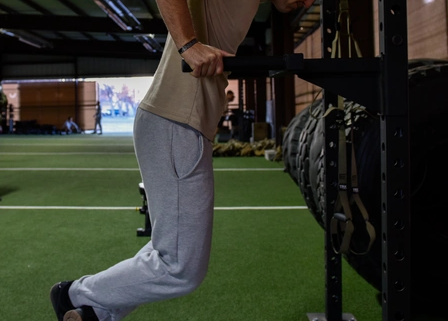
The dip machine trains the chest at a steep, downward pressing angle. A forward torso lean moves more of the work onto the lower chest, and an upright torso moves it onto the triceps. An assisted dip machine counterbalances part of your bodyweight, so you can build up to full dips with good reps. Once bodyweight dips are easy, add load with a belt. Stop the descent once your upper arm is a little below parallel. Going deeper puts stress on the front of the shoulder without adding much for the chest.
5. Machines vs. Free Weights: The Honest Take
Machines and free weights build similar amounts of muscle. Strength gains, however, are specific to the tool you trained with. A 2023 meta-analysis comparing free-weight and machine training found comparable hypertrophy, while strength improved most on the equipment used in training. For a tactical athlete, that specificity settles the question.
Your job puts force through your own body: pushing off the ground, moving a casualty, shoving through a doorway, posting a patient. A barbell or bodyweight press trains your trunk and shoulders to stabilize that force. A fixed path does some of the stabilizing for you. That’s why we treat functional strength for military performance as the base, and chest machines as a tool you add on top of it.
Machines are still valuable, and their main strength is safety near failure. Hypertrophy research shows that sets taken close to failure drive growth, but grinding a barbell to failure alone under a bench is a bad idea. On a machine, a failed rep just stops. So the practical rule is simple: press heavy with a barbell, dumbbells, or push-ups first, then add machine work for extra volume. Weekly volume is the main driver of growth, and research links about 10 or more hard sets per muscle per week with greater gains.
An all-machine chest workout makes sense in a few situations: a deload week, a second chest day in the same week, training around an injury, or a gym with no free bench. For everything else, the machines go after your main press.
Not sure how chest work fits into a full plan that also covers running and rucking? Our guide to choosing a strength & endurance program walks through what a balanced week has to include.
6. A Machine-Based Chest Workout
This chest day machine workout works as a second chest session in your week, or as accessory work after your main bench press (in that case, cut the first two moves to two sets each). Leave one to three reps in reserve on every set except the last set of each exercise, which you take close to failure.
Incline chest press machine: 3 sets of 6 to 10 reps, 2 to 3 minutes rest. Use it first, while you are fresh, to load the upper chest.
Flat chest press machine (or flat Smith press): 3 sets of 8 to 12 reps, 2 minutes rest. Builds overall mass.
Pec deck: 3 sets of 10 to 15 reps, 60 to 90 seconds rest, with a one-second pause in the stretch. Isolation after the triceps are tired.
Assisted or weighted dip machine: 2 to 3 sets of 8 to 12 reps, 90 seconds rest. Lean forward to work the lower chest.
Cable crossover (optional): 2 sets of 12 to 15 reps, 60 seconds rest. Use a low-to-high path for extra upper-chest work.
How to Progress the Workout
Use double progression. Once you hit the top of the rep range on every set of an exercise, add the smallest weight increment available next session and work back up. Train chest twice a week: research on training frequency shows that hitting a muscle at least twice a week supports more growth than once a week at the same volume. If you need a full-body template to build this into, start with a strength workout for athletes and use these machines as its pressing accessories.
If You Train at a Big-Box Gym
Big-box chains such as Planet Fitness usually have a selector-pin chest press, a pec deck (often a combined fly and rear-delt machine), a Smith machine, and an assisted dip and pull-up station. Free-weight benches may be limited. That’s enough to run the session above as written. Machine names and pivot points vary by brand, so judge each one by its movement, and expect your working weights to change from one brand to another.
If you want a version you can save and run, this workout is our free machine-based chest workout. If you’d rather have it built into a full program with running and load carriage, that’s what our programs are for.
Frequently Asked Questions
What machines at the gym work the chest?
The main machines at the gym that work the chest are the chest press (flat and incline), the pec deck or fly machine, the cable crossover, the Smith machine, and the assisted or weighted dip machine. The presses train the chest together with the front delts and triceps. The pec deck and crossover isolate the chest through a fly motion.
What is the best machine for chest at the gym?
The best machine for chest at the gym is the chest press, because it lets you press heavy loads safely with no spotter and no balance demand. If you can only use two, pair the incline chest press with the pec deck. That combination covers the upper chest, overall mass, and loaded stretch.
Can you build a chest with only machines?
Yes. Research shows machine training builds muscle at a similar rate to free weights when volume and effort are matched. The trade-off is strength transfer: strength improves most on the equipment you train with. For tactical work, keep at least one barbell, dumbbell, or push-up variation in your week.
Are chest machines as good as the bench press?
For building muscle, chest machines are roughly as good as the bench press. For pressing strength that carries over to your job and your fitness test, the bench press and push-ups are better, because they train the stabilizers a fixed machine path supports for you. Use the bench for strength and machines for extra volume.
What machine works the upper chest?
The incline chest press machine works the upper chest best, ideally at about 30 degrees, where upper-chest activation peaks in EMG research. An incline press on a Smith machine at the same angle is a strong alternative. A low-to-high cable fly adds isolation work for the upper chest.
How do you program a machine-based chest workout?
Program a machine-based chest workout with presses first and isolation last. Run an incline press, a flat press, a pec deck, and dips for about 10 to 12 total sets. Leave one to three reps in reserve and take the last set of each exercise close to failure. Add weight when you hit the top of your rep range, and train chest twice a week.
The chest machines at the gym worth using are the chest press, the pec deck, the cable crossover, the Smith machine, and the dip machine, and each has a specific job. Presses build mass, flies load the stretch, and the fixed paths let you push hard sets safely. Treat them as volume tools on top of a barbell or bodyweight pressing base, and you get the muscle without losing the strength your job requires. Run the workout above twice a week for the next eight weeks and track every load.
References:
Haugen ME, Vårvik FT, Larsen S, et al. Effect of free-weight vs. machine-based strength training on maximal strength, hypertrophy and jump performance: a systematic review and meta-analysis. BMC Sports Science, Medicine and Rehabilitation. 2023;15:103.
Schwanbeck SR, Cornish SM, Barss T, Chilibeck PD. Effects of training with free weights versus machines on muscle mass, strength, free testosterone, and free cortisol levels. Journal of Strength and Conditioning Research. 2020;34(7):1851-1859.
Saeterbakken AH, van den Tillaar R, Fimland MS. A comparison of muscle activity and 1-RM strength of three chest-press exercises with different stability requirements. Journal of Sports Sciences. 2011;29(5):533-538.
Rodríguez-Ridao D, Antequera-Vique JA, Martín-Fuentes I, Muyor JM. Effect of five bench inclinations on the electromyographic activity of the pectoralis major, anterior deltoid, and triceps brachii during the bench press exercise. International Journal of Environmental Research and Public Health. 2020;17(19):7339.
Lauver JD, Cayot TE, Scheuermann BW. Influence of bench angle on upper extremity muscular activation during bench press exercise. European Journal of Sport Science. 2016;16(3):309-316.
Solstad TEJ, Andersen V, Shaw M, et al. A comparison of muscle activation between barbell bench press and dumbbell flyes in resistance-trained males. Journal of Sports Science and Medicine. 2020;19(4):645-651.
Wolf M, Androulakis-Korakakis P, Fisher J, Schoenfeld B, Steele J. Partial vs full range of motion resistance training: a systematic review and meta-analysis. International Journal of Strength and Conditioning. 2023;3(1).
Refalo MC, Helms ER, Trexler ET, Hamilton DL, Fyfe JJ. Influence of resistance training proximity-to-failure on skeletal muscle hypertrophy: a systematic review with meta-analysis. Sports Medicine. 2023;53(3):649-665.
Schoenfeld BJ, Ogborn D, Krieger JW. Dose-response relationship between weekly resistance training volume and increases in muscle mass: a systematic review and meta-analysis. Journal of Sports Sciences. 2017;35(11):1073-1082.
Schoenfeld BJ, Ogborn D, Krieger JW. Effects of resistance training frequency on measures of muscle hypertrophy: a systematic review and meta-analysis. Sports Medicine. 2016;46(11):1689-1697.
Schoenfeld BJ, Fisher J, Grgic J, et al. Resistance training recommendations to maximize muscle hypertrophy in an athletic population: position stand of the IUSCA. International Journal of Strength and Conditioning. 2021;1(1).
American College of Sports Medicine. Progression models in resistance training for healthy adults. Medicine and Science in Sports and Exercise. 2009;41(3):687-708.
Haff GG. Roundtable discussion: machines versus free weights. Strength and Conditioning Journal. 2000;22(6):18-30.
Headquarters, Department of the Army. FM 7-22, Holistic Health and Fitness. October 2020.
Disclaimer: This article is for educational purposes and is not medical advice. Consult a qualified healthcare provider before starting a new training program, especially if you have a shoulder, elbow, or chest injury. Individual results vary.


