
Strength Endurance vs Muscular Endurance: Key Differences
Three qualities get used interchangeably in training, and they are not the same thing:
Muscular strength is the maximum force a muscle or muscle group can produce in a single effort.
Muscular endurance is the ability of a muscle or muscle group to sustain repeated contractions at a relatively low force for an extended period.
Strength endurance is the ability to produce moderate-to-high force repeatedly under accumulating fatigue.
Muscular strength is about how much. Muscular endurance is about how long. Strength endurance is about how many times you can produce meaningful force before it degrades.
Getting these mixed up is why athletes plateau on the tasks that matter. Someone who trains only for maximal strength cannot repeat efforts. Someone who trains only for muscular endurance cannot produce force when the load is real. Both keep military, law enforcement, and firefighter athletes performing under load, but they operate at different intensities and demand different training. Knowing which is which is what makes programming precise instead of guesswork, and precision is what CF ONE training programs are designed to deliver.
The Complete Comparison
Figure 1.1 - Muscular strength, strength endurance and muscular endurance compared across eleven dimensions. Definition, load, reps, rest, effort duration, fiber type, energy system, limiter, testing and a tactical example for each. Loads run from 85 to 100 per cent of one-rep max for maximal strength down to under 50 per cent for muscular endurance, with rest falling from three-to-five minutes to near-continuous. Two notes for anyone cross-checking: standard resistance-training guidelines divide muscular endurance from heavier work at 67 per cent of 1RM rather than 50, and have no separate "strength endurance" category - it occupies the band the reference table calls hypertrophy. Fiber-type rows describe dominance rather than exclusivity, since motor units are recruited in order of size.
The rows that matter most are load and rest. Those two variables are what actually separate the three qualities in a training session, and getting either wrong is how athletes train hard for months and build the wrong attribute.
Examples and Non-Examples of Muscular Endurance
The fastest way to understand a quality is to see what gets mistaken for it.
Figure 1.1 - Twelve activities sorted by whether they qualify as muscular endurance, and what each non-example is instead. A two-minute max push-up test, a three-minute plank, high-rep bodyweight squats, thirty minutes of steady cycling and holding grip on a charged hose line qualify; a one-rep max deadlift and a five-rep set at 90 per cent of 1RM are muscular strength, a vertical jump and a 100-meter sprint are power, a marathon is cardiovascular endurance because the limiter is oxygen delivery rather than local muscle fatigue, repeated heavy sandbag carries are strength endurance, and a held stretch is flexibility. Three questions sort all twelve: is the muscle producing force actively, is that force low and either repeated or sustained, and is the limiter local rather than central? Loading thresholds referenced against NSCA resistance-training program design guidelines - strength above 85 per cent of 1RM for fewer than six repetitions, muscular endurance below 67 per cent for more than twelve; oxygen-delivery limitation from Bassett & Howley, Medicine & Science in Sports & Exercise 32(1) 70–84, 2000.
The line that trips most people up is the last-but-one. Repeated heavy efforts feel like endurance because they are exhausting and repetitive, but the load is the deciding variable. If you could only manage the load a limited number of times to begin with, you are training strength endurance, not muscular endurance.
What Is Muscular Endurance?
Mechanically, muscular endurance lives in a muscle's resistance to local fatigue. It draws heavily on slow-twitch fibers, capillary density, and the muscle's ability to clear metabolic byproducts faster than they pile up.
Those byproducts are principally hydrogen ions and inorganic phosphate, which accumulate as the muscle works and progressively interfere with the contractile machinery. This is why muscular endurance is a local quality rather than a whole-body one. Your quadriceps can fail on a wall sit while your cardiovascular system is barely working, and your lungs can be at their limit on a hill run while no individual muscle has failed at all. That difference is exactly what separates muscular endurance from cardiovascular endurance.
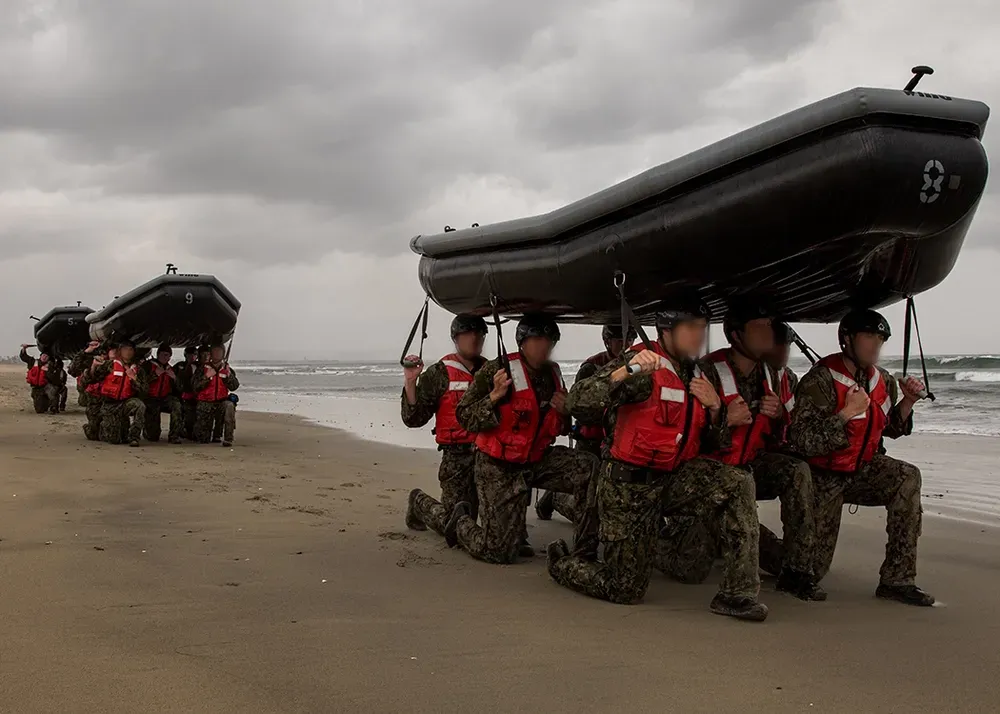
A soldier holding a firing position for several minutes, a firefighter keeping grip on a charged hose line, or a recruit grinding through a two-minute push-up test is expressing exactly this quality. The load stays light relative to maximum, but the duration and the sheer repetition are what tax the system and ultimately decide how long performance holds before it breaks down.
Muscular endurance is the ability of a muscle or muscle group to:
Perform repeated contractions
Sustain effort for long durations
Resist fatigue at relatively low force levels
Typical examples include:
High-rep bodyweight exercises
Long-duration plank holds
Steady-state cycling or rowing
Push-up or sit-up tests
Repetitive light-load tasks
Muscular endurance is often trained using:
Loads under roughly 50% of 1RM, or bodyweight
15 or more repetitions per set, frequently taken to or near failure
Short rest periods, typically under 60 seconds
Longer time under tension per set
How muscular endurance is measured. The standard field tests are max-repetition and timed-hold protocols:
Maximum push-ups or sit-ups performed in a fixed time window, usually one or two minutes. This is the format used by most military and law enforcement entry standards worldwide
Maximum repetitions to failure at a fixed submaximal load
Timed isometric holds such as a plank or wall sit
The common thread is that the load is fixed and low, and the score is either repetitions or time. That is the operational definition: if the test measures how many or how long rather than how much, it is measuring muscular endurance.
For athletes evaluating which hybrid training program best fits their strength-endurance development goals, the hybrid training program buying guide walks through exactly how to choose the right option.
What Is Strength Endurance?
The practical signature of strength endurance is a load heavy enough that you could only manage it a limited number of times, repeated again and again with little recovery.
Picture dragging a 180-pound casualty 50 meters, then doing it twice more under fire. Each drag demands a substantial fraction of maximal effort, far above the light loads that define muscular endurance, yet the task repeats until the objective is met. That repeated expression of high force under accumulating fatigue is precisely what separates strength endurance from simple stamina, and it is the quality most tactical jobs actually test.
Mechanically, the limiter is different from both neighbors. Maximal strength is limited by how much force you can generate once. Muscular endurance is limited by local fatigue resistance at low force. Strength endurance is limited by whether you can keep recruiting high-threshold motor units as fatigue accumulates. The first effort is rarely the problem. The fourth one is.
Strength endurance is the ability to:
Produce moderate-to-high force repeatedly
Sustain strength output over time
Perform demanding tasks under fatigue
It sits between:
Maximal strength (single heavy efforts)
Muscular endurance (low-force, long-duration efforts)
Examples include:
Carrying heavy equipment repeatedly
Dragging or lifting victims
Stair climbs with gear
Repeated sled pushes or pulls
Sustained grappling or control efforts
How strength endurance is trained. Loads of roughly 60 to 80% of 1RM, 6 to 15 repetitions per set, repeated across multiple rounds, with rest kept deliberately incomplete at 30 to 90 seconds. Incomplete rest is the defining variable. Full recovery between sets turns the session into strength work.
How strength endurance is measured. There is no single standard test, which is itself informative. The useful protocols are repeated-effort and task-specific:
A fixed heavy carry or drag repeated for time, scoring the drop-off between the first and last rep
Repeated sets at a fixed submaximal load with fixed short rest, scoring total quality reps before form breaks
Occupational task simulations, which is why most tactical fitness assessments now include loaded carries and drags rather than push-ups alone
The score that matters is degradation, not the first effort. An athlete whose fourth carry is 40% slower than the first has a strength endurance problem regardless of how strong they are.
Reviews of military occupational demands consistently describe job tasks built around repeated high-force efforts rather than low-intensity endurance alone. Nindl and colleagues, reviewing physical performance requirements for combat-centric military occupations, characterize the demands as lifting, carrying, dragging and repetitive load handling, which is the strength endurance profile rather than the aerobic one.
This makes strength endurance one of the most important qualities for real-world performance. For athletes with specific questions about tactical athlete program structure and what to look for in a system that develops both strength and endurance qualities together, the tactical athlete program FAQ covers the most common questions in one place.
Where Power and Cardiovascular Endurance Fit
Two more qualities get pulled into this conversation and both deserve a clean line.
Muscular power is force produced quickly. A vertical jump, a throw, a sprint start. It shares maximal strength's single-effort character but adds a time constraint: the question is not how much force but how fast you can express it. Power sits alongside maximal strength, not on the endurance side of the map at all.
Cardiovascular endurance is often confused with muscular endurance because both involve sustained effort. The difference is the limiter, and it is a clean test. Cardiovascular endurance is limited by how well your heart, lungs and blood deliver oxygen to working muscle across the whole body. Muscular endurance is limited by fatigue inside one muscle or muscle group.
The practical check: if you stop because you are out of breath and your heart rate is at the ceiling, that is cardiovascular. If you stop because one muscle group has failed while you could still hold a conversation, that is muscular. A wall sit is muscular endurance. A 10km run is cardiovascular endurance. A loaded ruck march is genuinely both, which is what makes it a good tactical test and a hard one to train for.
Why the Distinction Matters for Program Design
When athletes or coaches conflate these qualities, training priorities become unclear and results are unpredictable.
An athlete who trains primarily for muscular endurance will develop fatigue resistance at low force levels. They will improve their ability to sustain repetitive, moderate-effort tasks. But they will not develop the capacity to produce repeated high-force outputs when those are required.
An athlete who trains primarily for maximal strength will develop peak force production. But without density training and repeated-effort conditioning, that strength will not transfer to tasks requiring sustained output across multiple high-demand efforts.
Strength endurance occupies the gap between these two extremes. It requires both a strength foundation and the metabolic conditioning to express that strength repeatedly.
Practically, this means programs for tactical athletes must include:
Strength work at meaningful loads to build the force production capacity that strength endurance draws on
High-density conditioning that requires repeated force production at moderate to high intensity
Adequate recovery to allow adaptation to both demands simultaneously
Trying to develop strength endurance with only high-rep bodyweight circuits or only heavy lifting produces incomplete results. The training must match the quality being developed. Understanding what is strength-endurance gives this distinction its full physiological definition, explaining exactly what neuromuscular and metabolic mechanisms strength endurance relies on and why it requires different training stimuli than either muscular endurance or maximal strength.
Why Tactical Athletes Need Both
Real-world tactical tasks rarely fall into just one category. For example:
Climbing Multiple Flights of Stairs in Gear
Muscular endurance: sustained stepping
Strength endurance: carrying equipment weight
Grappling with a Suspect
Muscular endurance: sustained effort
Strength endurance: repeated high-force actions
Advancing a Hose Line
Muscular endurance: continuous movement
Strength endurance: pulling against resistance
What these examples share is that no single quality carries the task alone. The stair climb in gear is a muscular-endurance problem stacked on a strength-endurance problem; the grapple is a strength-endurance problem riding on an aerobic base. Train only one and the missing quality becomes the hard ceiling on performance, you fail at whichever demand you neglected, not the one you trained.
This is why tactical programming treats muscular endurance and strength endurance as complementary rather than interchangeable, building each deliberately so the weakest link never gets to decide the outcome. Research on military and tactical tasks shows that performance depends on a combination of strength, endurance, and work capacity. Focusing on only one quality leaves performance gaps.
How Each Quality Is Developed
Developing each quality means matching the training stimulus to the adaptation you want. The variables that decide the outcome are load, repetition range, rest, and total time under tension, and they pull in opposite directions for each quality. Get the prescription wrong and you can train hard for months while building the wrong attribute entirely. The two approaches below are not interchangeable, and serious tactical athletes rotate between them across a training cycle rather than living permanently in one. Knowing why each method produces its specific result is what turns programming from random circuits into deliberate progress.
Training for Muscular Endurance
Typical methods:
Bodyweight circuits
Light resistance with high reps
Long-duration sets
Minimal rest periods
Purpose:
Improve fatigue resistance
Support long-duration efforts
Build work capacity
Training for Strength Endurance
Typical methods:
Moderate loads
Moderate repetitions
Repeated effort circuits
Short-to-moderate rest intervals
Purpose:
Sustain force under fatigue
Improve task-specific performance
Prepare for real-world demands
The Role of Max Strength
Both muscular endurance and strength endurance are built on a base of strength.
Stronger muscles:
Fatigue more slowly
Handle loads more efficiently
Reduce joint stress
Improve endurance at submaximal loads
The mechanism is straightforward: a task feels easier the smaller a fraction of your maximum it represents. If your maximal deadlift is 225 pounds, a 135-pound sandbag is 60 percent of your max; raise that deadlift to 315 and the same sandbag drops to 43 percent. Every repetition now costs less, fatigue accumulates more slowly, and your endurance at that load climbs without a single extra endurance set.
That is why raising maximal strength quietly improves both endurance qualities at submaximal loads. The floor rises and everything above it gets cheaper. Research consistently shows that increased maximal strength improves performance in repeated-effort tasks (Suchomel et al., 2016). Without a strength foundation, endurance qualities are limited.
How to Structure Training That Develops Both
Athletes and coaches who understand the distinction between muscular endurance and strength endurance can build programs that develop both systematically without each undermining the other.
A practical approach:
Early in a training cycle, prioritize strength base development. This builds the force production ceiling that both muscular endurance and strength endurance draw from. Higher maximal strength makes every submaximal effort less costly.
Mid-cycle, introduce density-focused strength endurance work. Moderate loads, shorter rest, repeated-effort circuits. This teaches the neuromuscular system to produce meaningful force across multiple efforts under accumulating fatigue.
Later in the cycle, add higher-volume muscular endurance work and conditioning that sustains effort over longer durations. This builds the aerobic and metabolic base that supports the full demand of operational tasks.
Recovery management across all three phases is non-negotiable. Both muscular endurance and strength endurance adaptations require adequate sleep, nutrition, and training variation to consolidate. The full framework for structuring these qualities across a training cycle is covered in a framework for strength-endurance balance, which maps exactly how to prioritize, sequence, and progress both qualities without one undermining the other.
Common Training Mistakes
Most programming errors come from treating one quality as a substitute for the whole. The athlete who is strong on a single max lift assumes that strength will carry repeated efforts; the high-rep specialist assumes volume builds force. Neither holds up under real demand. The mistakes below are common precisely because each method genuinely works for the quality it targets, which makes it tempting to over-rely on it and call the job done. The fix is rarely to abandon a method. It is to stop expecting it to deliver an adaptation it was never built to produce.
Only Training Muscular Endurance
Programs focused only on:
High-rep circuits
Bodyweight exercises
Long cardio sessions
may lead to:
Lack of force production
Poor load tolerance
Reduced operational performance
Only Training Max Strength
Heavy lifting alone:
Does not prepare athletes for repeated efforts
Leaves endurance gaps
Increases fatigue during sustained tasks
Ignoring Progression
Random circuits without structure:
Limit long-term improvement
Increase fatigue
Do not build real capacity
Both qualities should be trained progressively.
The Aerobic Capacity Connection
Both muscular endurance and strength endurance benefit from a well-developed aerobic base. Aerobic capacity underpins recovery between efforts. It determines how quickly an athlete returns to a functional state after a high-demand bout. A stronger aerobic system means shorter recovery periods between repeated strength-endurance efforts and less accumulation of fatigue across a session.
This is why programs that neglect low-intensity aerobic development in favor of constant high-intensity work produce athletes who perform well on single efforts but fade significantly when efforts must be repeated.
For tactical athletes, the connection between aerobic capacity and strength endurance is not theoretical. It is the difference between sustaining operational performance across a full shift or task duration and degrading after the first high-demand effort. The direct contrast in aerobic capacity vs work capacity clarifies the relationship between these qualities, showing why aerobic development is a precondition for the work capacity that both muscular endurance and strength endurance ultimately express.
Practical Takeaways
To develop both strength endurance and muscular endurance:
Build a solid strength foundation
Include high-rep endurance circuits
Add moderate-load strength endurance sessions
Maintain aerobic conditioning
Progress loads and volume gradually
Muscular strength lets you produce force.
Muscular endurance helps you keep moving.
Strength endurance helps you keep producing force.
Tactical performance requires all three.
Understanding what is work capacity gives every athlete reading this post the complete performance definition that both qualities are ultimately building toward, explaining what work capacity is, why it matters, and how muscular endurance and strength endurance each contribute to it in distinct ways. The specific application of these qualities to load carriage, one of the most operationally relevant tactical tasks, is covered in strength-endurance for load carriage, which connects the distinction in this post to the real demands of carrying weight over distance under fatigue.
Frequently Asked Questions
What is the difference between muscular strength and muscular endurance?
Muscular strength is the maximum force you can produce in a single effort, measured by how much weight you can move once. Muscular endurance is how many times you can move a light load, or how long you can hold one, before the muscle fails. Strength is a question of magnitude, endurance is a question of duration or repetition. A one-rep max deadlift tests strength. A two-minute push-up test tests endurance.
What is muscular endurance in simple terms?
The ability of a muscle to keep working at a low force for a long time without giving out. Holding a plank, doing 50 bodyweight squats, or maintaining a firing position all rely on it.
What are some non-examples of muscular endurance?
A one-rep max lift, a vertical jump, a 100-meter sprint, and a marathon are all non-examples. The first three are too short and too intense: they test strength or power. A marathon is limited by oxygen delivery across the whole body rather than fatigue in a single muscle, which makes it cardiovascular endurance. Heavy repeated carries are also a non-example, because the load is too high. That is strength endurance.
Is muscular endurance the same as cardiovascular endurance?
No. Muscular endurance is local, meaning one muscle or muscle group fatigues. Cardiovascular endurance is systemic, meaning your heart, lungs and blood cannot deliver enough oxygen. The check is what stops you: a failed muscle while you can still talk is muscular, being unable to breathe while no single muscle has failed is cardiovascular.
How is muscular endurance measured?
With max-repetition or timed-hold tests at a fixed low load. The common protocols are maximum push-ups or sit-ups in one or two minutes, maximum repetitions to failure at a submaximal weight, and timed isometric holds such as a plank. If the test scores how many or how long rather than how much, it is measuring endurance.
Which is better, strength or endurance?
Neither, and the question usually means the asker has a specific task in mind. Match the quality to the demand. If the task is a single heavy effort, train strength. If it is sustained light work, train endurance. Most real-world tasks, especially occupational ones, sit between the two and require strength endurance, which is why training only one extreme leaves a gap.
Can you build muscular strength and muscular endurance at the same time?
Yes, though not at the same rate as focusing on one. The usual approach is to sequence them: build a strength base first, then layer density and repeated-effort work on top of it, then add higher-volume endurance work. Raising maximal strength also improves endurance at submaximal loads for free, because every rep becomes a smaller fraction of your maximum.
References
Nindl, B. C., Jones, B. H., Van Arsdale, S. J., Kelly, K., & Kraemer, W. J. (2016). Operational physical performance and fitness in military women: Physiological, musculoskeletal injury, and optimized physical training considerations for successfully integrating women into combat-centric military occupations. Military Medicine, 181(1 Suppl), 50-62.
Suchomel, T. J., Nimphius, S., & Stone, M. H. (2016). The importance of muscular strength in athletic performance. Sports Medicine, 46(10), 1419-1449.
Schoenfeld, B. J. (2010). The mechanisms of muscle hypertrophy and their application to resistance training. Journal of Strength and Conditioning Research, 24(10), 2857-2872.


