
Is Leg Press a Compound Exercise? Yes | Combat Fitness
Is the Leg Press a Compound Exercise? Yes, With One Important Caveat
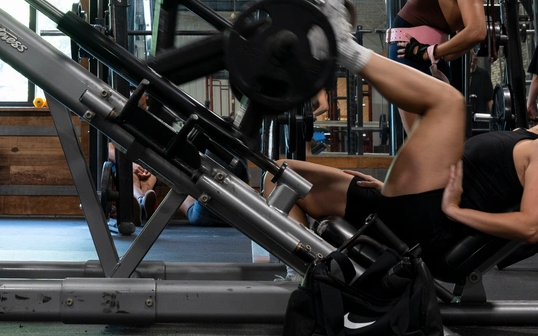
Is leg press a compound exercise? Yes. The leg press is a compound, multi-joint exercise because it extends your hips and knees together, loading the quads, glutes, and adductors in one movement. The caveat: it is a machine-guided compound, so the sled handles the balance and bracing a free-weight squat demands. That difference matters for anyone training for a job, and it is why our tactical fitness programs use the leg press as an accessory, not the main lift.
We program leg strength for soldiers, operators, and firefighters who carry, drag, and climb under load. Below: why it counts, what the machine takes away, and where it belongs.
Why Does the Leg Press Count as a Compound Exercise?
The leg press counts as a compound exercise because more than one joint moves under load. Your hips and knees both flex on the way down and extend on the way up, with the ankles assisting. A compound, or multi-joint, exercise is defined by exactly that: several joints and muscle groups working together (Haff & Triplett, 2016).
Compound vs. Isolation: The Definition
Compound (multi-joint): two or more joints move under load. Squats, deadlifts, lunges, and the leg press all qualify.
Isolation (single-joint): one joint moves. The leg extension (knee only), leg curl (knee only), and calf raise (ankle only) are the lower-body examples.
So is the leg press compound or isolation? Compound. Its closest isolation cousin is the leg extension, which uses a similar seat but moves only the knee.
The label matters because multi-joint lifts move more load and train muscles to produce force together, which is why strength guidelines emphasize them (American College of Sports Medicine, 2009; Gentil et al., 2015).
What Muscles Does the Leg Press Work?
Quadriceps: the prime movers for knee extension and the most heavily recruited group (Escamilla et al., 2001; Da Silva et al., 2008).
Glutes and adductor magnus: drive hip extension, working harder at deeper ranges.
Hamstrings: assist hip extension, with lower activation than in the squat (Escamilla et al., 1998).
Calves: stabilize the ankle against the platform.
Foot position shifts the emphasis. A higher, wider stance puts more work on the hips, while a lower stance increases knee travel and quad demand (Escamilla et al., 2001).
The Caveat: Machine-Guided vs. Free-Weight Compound
The leg press is compound, but it is not equivalent to a free-weight compound like the back squat. The sled runs on a fixed track and your back rests against a pad, so you never balance the load, brace your trunk against it, or control its path. Those are the qualities that carry over to work in the field.
Free-weight squats produce more total muscle activity than the same movement on a guided machine, because stabilizers have to work (Schwanbeck et al., 2009). Stability demands also change how force is produced and controlled (Behm & Anderson, 2006). In a training study comparing the two lifts, squat training improved jump performance while leg press training did not (Wirth et al., 2016).
What You Gain and What You Give Up
What the leg press gives you:
Heavy quad loading without balance as the limiting factor.
Far less axial load on the spine than a bar across your back.
Lower systemic fatigue, so you recover faster between sessions.
A safer way to push sets close to failure, since there is no bar to bail.
What it takes away:
Trunk bracing under load.
Balance and standing stability.
Hip and ankle control through a free movement path.
Direct carryover to lifting and carrying from the ground.
A ruck, a casualty, or a charged hose line does not ride on rails. That is the case for functional strength for military performance: strength built standing, braced, and balanced.
Is the Seated or Single-Leg Press Still Compound?
Yes. The seated (horizontal) and 45-degree leg press both move the hips and knees, so both are compound. The single-leg press is compound and unilateral, useful for exposing a side-to-side gap. The machine caveat applies to every version.
How to Use the Leg Press: Accessory, Not Main Course
Use the leg press after your main squat or hinge, as accessory quad volume. For a tactical athlete, the free-weight squat stays the priority because it builds the braced, standing strength the job tests. The leg press adds work when your back or recovery cannot handle more squatting.
Where the Leg Press Fits
Accessory volume: 3 to 4 sets of 10 to 15 reps after your main squat.
High-rep quad work: sets of 15 to 25 build the leg endurance that rucking and stair climbs draw on.
Loading around a limitation: when a back or shoulder issue keeps a bar off your back and a provider has cleared you to train legs.
High-fatigue blocks: during heavy ruck or selection-prep phases, it trains legs without the systemic cost of more heavy squats.
Keep your hips on the pad and stop before your lower back rounds, because that rounding loads the lumbar spine. Press through the whole foot and do not snap into lockout.
Where the Squat Stays Primary
Your first lower-body lift should be a back squat, front squat, or trap-bar deadlift. Army doctrine and military strength research both put free-weight, multi-joint lifts at the center of warfighter training (Department of the Army, 2020; Kraemer & Szivak, 2012). The structure for that work lives in a strength workout for athletes.
Weighing plans? Pick one that treats machines as support. Our guide to choosing a strength & endurance program covers what to look for.
Frequently Asked Questions
Is the leg press a compound exercise?
Yes. The leg press is a compound exercise because your hips and knees both bend and extend under load. It trains the quads, glutes, adductors, and hamstrings together, but as a machine-guided compound it skips the balance and bracing of a free-weight squat.
Is the leg press compound or isolation?
The leg press is compound. Isolation exercises move one joint, like the leg extension or leg curl. The leg press moves the hip and knee together, which puts it in the multi-joint category with the squat, deadlift, and lunge.
What muscles does the leg press work?
The leg press works the quadriceps hardest, followed by the glutes and adductor magnus. The hamstrings assist, less than in a squat, and the calves stabilize the ankle. A higher foot position shifts work to the hips; a lower one biases the quads.
Is the leg press as good as a squat?
Not for a tactical athlete. The leg press builds leg strength and size with less fatigue and spinal load, but it skips the balance and bracing a squat trains. Squats also carry over better to athletic qualities like jumping, so the squat stays the main lift.
Is the seated leg press still compound?
Yes. The seated leg press moves the hips and knees together, the same as the 45-degree version, so it is compound. The horizontal angle changes how the load feels, not the joints involved. The single-leg press is also compound, done one leg at a time.
Should you do the leg press or the squat?
Do both: squat first, leg press second. The squat builds the standing, braced strength your job requires, and the leg press adds quad volume without the fatigue of more squat sets. If you only have time for one, choose the squat.
Is leg press a compound exercise? Yes, it is a multi-joint lift that trains your hips and knees together. It is also a machine compound, and that caveat decides its role: accessory volume behind a free-weight squat, never a replacement for it. Start a Combat Fitness program that puts your squat first and builds every accessory around it.
References:
American College of Sports Medicine. Progression models in resistance training for healthy adults. Medicine and Science in Sports and Exercise. 2009;41(3):687-708.
Behm DG, Anderson KG. The role of instability with resistance training. Journal of Strength and Conditioning Research. 2006;20(3):716-722.
Da Silva EM, Brentano MA, Cadore EL, De Almeida AP, Kruel LF. Analysis of muscle activation during different leg press exercises at submaximum effort levels. Journal of Strength and Conditioning Research. 2008;22(4):1059-1065.
Department of the Army. FM 7-22, Holistic Health and Fitness. Washington, DC: Headquarters, Department of the Army; 2020.
Escamilla RF, Fleisig GS, Zheng N, Barrentine SW, Wilk KE, Andrews JR. Biomechanics of the knee during closed kinetic chain and open kinetic chain exercises. Medicine and Science in Sports and Exercise. 1998;30(4):556-569.
Escamilla RF, Fleisig GS, Zheng N, et al. Effects of technique variations on knee biomechanics during the squat and leg press. Medicine and Science in Sports and Exercise. 2001;33(9):1552-1566.
Gentil P, Soares S, Bottaro M. Single vs. multi-joint resistance exercises: effects on muscle strength and hypertrophy. Asian Journal of Sports Medicine. 2015;6(2):e24057.
Haff GG, Triplett NT, eds. Essentials of Strength Training and Conditioning. 4th ed. Champaign, IL: Human Kinetics; 2016.
Kraemer WJ, Szivak TK. Strength training for the warfighter. Journal of Strength and Conditioning Research. 2012;26(Suppl 2):S107-S118.
Schwanbeck S, Chilibeck PD, Binsted G. A comparison of free weight squat to Smith machine squat using electromyography. Journal of Strength and Conditioning Research. 2009;23(9):2588-2591.
Wirth K, Hartmann H, Sander A, Mickel C, Szilvas E, Keiner M. The impact of back squat and leg-press exercises on maximal strength and speed-strength parameters. Journal of Strength and Conditioning Research. 2016;30(5):1205-1212.
Disclaimer: This article is for educational purposes and is not medical advice. If you have an injury, pain, or a diagnosed condition, get cleared by a qualified medical provider before starting a new exercise program. Stop any exercise that causes sharp or worsening pain.


