
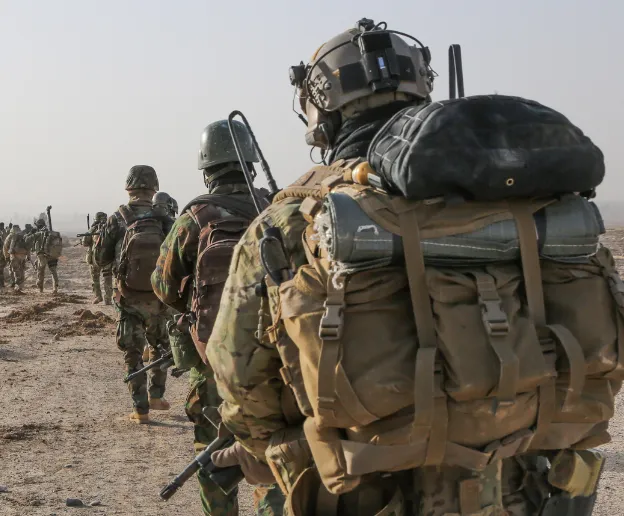
CrossFit vs. Tactical Fitness: The Deadly Difference
CrossFit vs. Tactical Fitness: Why Sport Programming Can Get You Killed
CrossFit vs. tactical fitness is not a rivalry, it's a category error. CrossFit is a great sport, and it made millions of people train hard. But it was never built to be a tactical training program, and confusing sport performance with job requirements is how good athletes end up hurt, sidelined, or worse. For military, law enforcement, and first responders, the gap between the two isn't academic.
In CrossFit, the goal is to win the workout. To go faster. To do more reps. In Tactical Fitness, the goal is to complete the mission and come home. The difference is not subtle. It is the difference between training for a leaderboard and training for a career. Tactical athletes need programs built around that distinction, and CF ONE training programs are structured specifically around operational outcomes, not sport performance metrics.
Here is why every tactical athlete needs to modify the CrossFit "WOD" (Workout of the Day), and the five-part filter for doing it.
1. Risk vs. Reward: The CrossFit Box Jump Problem
In CrossFit, you do high-rep box jumps for time. When you get tired, your form breaks. You clip your shin. Or worse, you blow an Achilles tendon rebounding.
Tactical View: An Achilles tear takes you off the street for 9 months. The risk is not worth the reward.
The Fix: Step-ups. Same conditioning effect, zero rupture risk.
Why the Risk Calculation is Different for Tactical Athletes
A competitive CrossFit athlete who tears an Achilles faces a setback. A law enforcement officer or soldier who tears an Achilles faces a different consequence: removed from duty, possibly at the worst possible moment. The injury is the same. The cost is not. For tactical athletes deciding which program structure fits their background and goals, the tactical fitness program buying guide walks through exactly how to evaluate your options.
This is the core of the tactical filter. Every exercise selection must pass one question: if this goes wrong, what does it cost? When the answer is months off the street or out of the field, the movement fails the filter regardless of how much aerobic benefit it provides. The risk tolerance of a competitive athlete and an operational professional are simply not the same, and programs that ignore this distinction put careers, and missions, at risk.
Published research backs this risk logic. A systematic review of 25 studies covering more than 12,000 CrossFit practitioners (Rodríguez et al., The Physician and Sportsmedicine, 2022) found the shoulder, spine, and knee were the most frequently injured regions, with reported injury rates ranging from 0.2 to 18.9 per 1,000 training hours. The same review identified competition participation and lack of coaching supervision as risk factors, the exact conditions a redlining, time-capped WOD creates. For a tactical athlete, those odds are not a leaderboard question. They are a duty-status question.
2. Olympic Lifting (High Rep Snatches)
The Snatch is a highly technical move. Doing 30 of them for time when your heart rate is 180bpm is a recipe for a shoulder labrum tear.
Tactical View: You never need to snatch a suspect overhead.
The Fix: Sandbag Cleans or Kettlebell Swings. High metabolic output, low technical failure risk.
The Specificity Problem with Sport Movements
The Snatch is a brilliant expression of human athleticism. It is also a movement that requires hundreds of hours of technical practice to perform safely under fatigue. When CrossFit programs it for time, at high volume, they are assuming that the athlete has that technical foundation. Many do not. For athletes with specific questions about tactical training program structure and selection, the tactical fitness program FAQ covers the most common questions in one place.
For tactical athletes, the calculus is worse. The movement does not transfer. No operational task requires the overhead snatch position. The metabolic benefit is real, but it can be achieved through movements that carry minimal technical failure risk and produce direct carryover to actual job demands. Sandbag cleans teach the hip drive, force transfer, and grip endurance that matter in a real carry or drag scenario. Kettlebell swings develop posterior chain power and aerobic capacity without putting a loaded bar overhead at the limit of technical breakdown. Specificity is not just about what muscles work. It is about what happens when things go wrong.
3. Pacing: Redlining vs. Threshold Management
CrossFit rewards "Redlining," going 100% until you collapse. Tactical View: If you redline in a foot chase, you have nothing left for the fight at the end. You need to train "Threshold Management," working hard, but keeping 10% in the tank for the critical moment.
Why Threshold Management is a Tactical Skill
In competition, burning everything is rational. The clock stops. The workout ends. Recovery begins. In an operational context, the clock does not stop. A foot pursuit does not end with a rest period. A firefight does not pause because you are gassed.
Tactical athletes must train the ability to work at a high percentage of maximum output while preserving enough reserve for the event at the end. This is a trainable skill. Most CrossFit programming actively works against it by conditioning athletes to associate maximum effort with success. The athlete who learns to redline wins workouts. The operator who learns threshold management survives the job. Understanding what is tactical conditioning gives this threshold management approach its full operational context, explaining why aerobic base and energy system balance are non-negotiable for any athlete whose performance must extend beyond the end of the workout.
This requires a different approach to conditioning: structured aerobic base development, controlled threshold work, and deliberate practice at sustained moderate output. The goal is not to avoid hard work. The goal is to never arrive at a critical moment with nothing left.
The physiology behind this is straightforward. Redlining drains the anaerobic glycolytic system fast, and once it's spent, power output collapses until the aerobic system can restore it, a process that takes minutes you may not have. A well-developed aerobic base widens that buffer, clears metabolic byproducts faster, and lets you repeat hard efforts with shorter recovery. That is why tactical conditioning prioritizes the aerobic capacity sport programming often treats as an afterthought. The reserve isn't a luxury. It's the margin between finishing the task and failing it.
4. Recovery Mismatch
CrossFit programming is generally designed for athletes whose primary job is training. The average CrossFit athlete recovers between workouts, manages their own schedule, and chooses when to push and when to pull back.
Tactical athletes do not have that luxury. A soldier in a training cycle may be carrying sleep debt, managing operational stress, and absorbing physical wear from duties that have nothing to do with the gym. A law enforcement officer working nights is not in the same recovery state as an athlete sleeping eight hours in a temperature-controlled room.
Programs that ignore recovery mismatch pile prescribed intensity on top of an already-stressed system. The result is not adaptation. It is accelerated breakdown. Effective tactical programming accounts for the total stress load of the athlete's life, not just the stress generated inside the training session. The distinction between a tactical athlete vs hybrid athlete clarifies exactly where the civilian performance athlete ends and the occupational requirement begins, making it the right next read for athletes unsure which category they are actually training for and how recovery balance comes into play.
5. The Durability Standard: Training for a 20-Year Career
The final filter is time. A competitive CrossFit athlete has a performance window of several years at the top level. A tactical athlete needs to perform across a career that may span two or three decades. The training decisions made at 25 have consequences at 45.
Movements that carry high injury risk, programming that ignores recovery, and intensity cultures that reward suffering over structure all compress the performance window. Tactical fitness prioritizes the long game: building a body that is capable, durable, and reliable not just this year, but across an entire career of service.
Consider two athletes at 25, training side by side. One chases every PR and competition, eats the injuries as the cost of the sport, and stacks shoulder and lumbar wear year over year. The other trains hard but filters every movement for risk and builds an aerobic base that supports recovery. At 35, the first is managing chronic pain and modifying around old injuries; the second is still passing selection-grade standards. At 45, the gap is a career. Durability is not the opposite of intensity, it's intensity that lasts.
The Tactical Filter: A Decision Framework
Use the methodology of CrossFit (constantly varied, functional movements, high intensity), but apply a Tactical Filter before every exercise selection. The Tactical Filter is not a rejection of CrossFit's engine. Constantly varied, functional movement at intensity is a genuinely effective way to build work capacity, that part stays. What changes is the gate every exercise has to pass before it earns a place in the program. A competitive athlete optimizes for the scoreboard. A tactical athlete optimizes for the next 20 years of showing up fit for duty. The filter is simply how you keep the engine while removing the movements that quietly trade your career for a faster time.
Ask three questions:
What is the injury risk if this breaks down under fatigue?
Does this movement transfer to an actual operational demand?
Does this intensity level support threshold management or undermine it?
If an exercise fails any of those three tests, replace it. Not because hard work is bad. Because the goal is not to win the workout. The goal is to be ready when it counts.
If an exercise has a high risk of injury (kipping pullups, rebounding box jumps), cut it. Replace it with a grinder movement (strict pullups, step-ups). Train to be an asset, not a patient. The direct contrast between tactical conditioning vs general fitness unpacks exactly why the environment and purpose of training changes what good programming looks like, and why the sport fitness model fails when applied to operational demands.
The tactical athlete performance pyramid maps the structural hierarchy of how aerobic base, strength, and operational capacity are correctly ordered, giving every athlete who has read this post the architectural framework for building training that actually transfers. For athletes ready to understand the full professional identity behind why these training decisions matter, what is a tactical athlete defines the kind of operator this post's training philosophy is designed to build and protect.
Summary
Use the methodology of CrossFit, but apply a Tactical Filter. The energy systems are the same. The risk tolerance is not. The performance window is not. The recovery context is not.
The fix is not abandoning intensity. It is directing intensity toward outcomes that matter: durability, threshold management, and operational readiness across a full career. The full definition of what is tactical fitness draws this line with precision, defining what tactical training is actually optimizing for and why sport fitness falls short of that standard.
FAQ
Is CrossFit bad for tactical athletes?
Not inherently. The methodology is sound. The problem is applying sport programming to an operational context without modification. Intensity, variety, and functional movements are all valuable. The selection of specific exercises and the approach to pacing and recovery require a tactical filter.
What is the difference between sport fitness and tactical fitness?
Sport fitness optimizes for a performance event under controlled conditions. Tactical fitness optimizes for reliable, repeatable performance under stress across a full career. The goals, timelines, and risk tolerances are different.
What movements should tactical athletes avoid?
Any movement that carries high injury risk under fatigue without direct operational transfer. High-rep Olympic lifting for time, rebounding box jumps, and kipping pullups are common examples. Replace them with movements that produce the same conditioning effect with lower failure risk.
How should tactical athletes approach conditioning intensity?
Through threshold management rather than redlining. Build a strong aerobic base, train at controlled intensities most of the time, and apply high intensity strategically. The goal is to arrive at critical moments with reserve capacity, not empty.


