
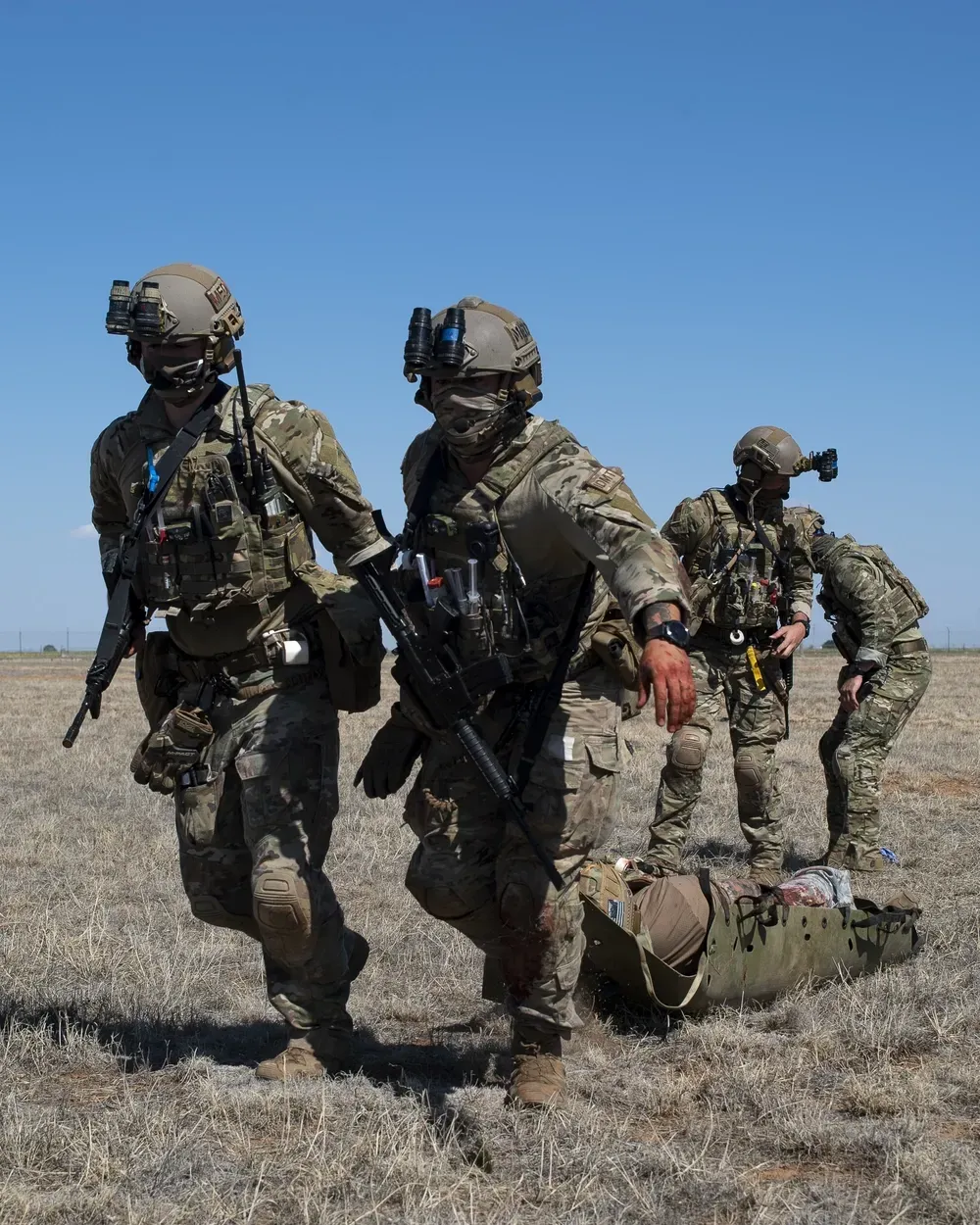
What Is Tactical Readiness? Definition and How to Build It
Tactical readiness is your real-time ability to perform required physical, mental, and tactical tasks at a high level under operational demands, right now, on the day it's tested. It's a term you've heard across military and high-performance spaces, but it's routinely confused with fitness, and the difference is the whole point. Fitness is the capacity you've built over months; tactical readiness is how much of that capacity you can actually express today, after sleep, stress, workload, and recovery have all had their say.
Simply put, tactical readiness is your ability to perform optimally in high-demand, real-world situations, physically, mentally, and behaviorally, at any given moment. Athletes who want programming specifically designed to develop and maintain this state can explore our CF ONE tactical readiness programs. It’s not just fitness. It’s not just motivation. It’s the composite state of preparation that determines whether you can execute under pressure, uncertainty, and fatigue.
For tactical athletes, operational personnel, and performance-driven individuals, readiness is the performance metric that matters most.
A Note on the Word "Readiness"
If you have served, you were taught a different definition of this word, and it is worth reconciling the two before going further.
In doctrine, readiness is a force-level concept. Joint Publication 1 defines readiness as the ability of military forces to fight and meet the demands of assigned missions. That is an institutional measurement, manning, training, equipping, sustaining, and it is reported up a chain. Related official terms follow the same logic: combat readiness, materiel readiness, personnel readiness, weapons readiness state.
"Tactical readiness" in that system means an echelon, not a person. The Army frames readiness across three levels, tactical, operational, and strategic, where tactical refers to a unit's ability to accomplish its assigned mission, operational to a corps-level capability, and strategic to the Army's capacity to project force globally. A commander asking about tactical readiness is asking about a formation, not about whether you slept.
This article uses the individual sense, which is how human-performance practitioners use the term: your own real-time capacity to perform, measured on the day. Both usages are legitimate and they are related, a unit's readiness is built out of the readiness of the people in it, but they are not the same measurement and they are not reported the same way.
If you arrived here looking for the doctrinal definition, MilitaryDictionary and the Congressional Research Service publications cover it properly. If you arrived here wanting to know why you feel sharp one week and flat the next despite training the same, keep reading.
Tactical Readiness Defined
Tactical readiness combines several components:
Physical preparedness - strength, power, endurance, mobility, stability
Cognitive performance - decision-making, focus, awareness
Emotional regulation - stress resilience, emotional control
Recovery state - sleep, nutrition, autonomic balance
In short: readiness is the sum of your ability to perform well right now. It’s not about long-term potential, it’s about present-moment capability. For athletes evaluating which program structure best develops this state, the military fitness program buying guide walks through how to match training design to readiness-focused goals. These four components don't operate in isolation, they compound. A patrol officer can deadlift well above standard, but if he's running on four hours of sleep after back-to-back night shifts, his reaction time slows, his stress tolerance thins, and his autonomic system never fully resets. On paper he's prepared. In the moment he's degraded. Readiness measures the system as a whole, on the day it's tested, which is why two athletes with identical fitness profiles can show up to the same evaluation in completely different states.
This is what separates being fit from being ready.
How Readiness Differs from Fitness
Fitness:
Represents long-term capacity
Improves slowly with consistent training
Is somewhat slow to fade
Tactical readiness:
Fluctuates daily (or even hourly)
Is influenced by sleep, stress, recovery, workload
Determines what you can express at a given session or mission
Figure 1.1 Fitness vs. tactical readiness compared. Seven axes separating built capacity from expressible capacity: what each is, timescale, how fast each changes, how each is lost, how each is measured, how each is managed, and what each tells you. Fitness moves over months to years and decays slowly, two weeks of complete rest costs an endurance athlete only about 4% of VO₂ max, and resistance-training strength holds for 16–24 weeks. Tactical readiness moves in hours to days: a single night of lost sleep reduces physical performance by roughly 7.56%, with afternoon and evening efforts hit hardest. Fitness sets the ceiling; readiness sets the percentage of it available today. Sources: Craven et al., Sports Medicine (2022); Frontiers in Physiology detraining review (2023); Ferreira-Junior et al., Muscles (2022); Ramos-Campo et al., Applied Sciences (2020).
A soldier may have elite fitness but be low on readiness after poor sleep, long shifts, or psychological stress. Conversely, someone in moderate condition can have high readiness on a good day. The timescale difference is what trips people up. Fitness is built over months and lost slowly, detrain for two weeks and your engine is largely intact. Readiness moves on a scale of hours to days: a single bad night, a stressful shift, or a skipped meal can pull it down fast, and a good night's recovery can restore it just as quickly. This volatility is the entire reason readiness has to be managed actively rather than assumed. You earn fitness once; you protect readiness daily.
Understanding this distinction allows better planning, pacing, and performance optimization. For common questions about how to build a program that accounts for this gap, the tactical fitness program FAQ covers the most important variables to understand before committing to a training approach.
Key Components of Tactical Readiness
Cognitive Readiness
Fast, accurate decision-making matters in high-pressure environments. Cognitive readiness includes:
Situation awareness
Reaction time
Task switching
Focus under stress
Poor cognitive readiness undermines even the best physical preparation. Cognitive load behaves like a depletable resource. Sustained vigilance across a long duty cycle, rapid target discrimination, and constant task-switching all draw down the same attentional reserve, and once it's spent, decision speed and accuracy fall off before physical output does. This is why a fatigued operator misreads a situation he'd handle cleanly when fresh. Building cognitive readiness means training under realistic distraction and time pressure, not just rehearsing skills in calm conditions where the attentional cost is artificially low.
Physical Readiness
Physical skills matter, but they aren’t enough on their own. Physical readiness includes:
Strength and power
Endurance and stamina
Mobility and stability
Movement quality under load
These abilities must be accessible in real time, not just in practice. The distinction that matters here is availability versus existence. A one-rep max recorded in a controlled gym session tells you a capacity exists; it says nothing about whether that capacity is accessible after a ruck march, a poor night's sleep, or three consecutive hard training days. Physical readiness is the portion of your fitness you can actually express right now, under load and fatigue. Programming that ignores this gap produces athletes who test well in isolation and underperform the moment conditions stop cooperating.
Psychological & Emotional Readiness
Stress, mental fatigue, and emotional state all influence performance. Emotional readiness includes:
Stress resilience
Confidence under pressure
Self-regulation
Psychological recovery
High emotional readiness allows athletes and operators to perform consistently, even when the situation is unpredictable. Psychological stress isn't just a mindset problem, it carries a measurable physiological cost. Research by Stults-Kolehmainen and Seffrin (2014) found that life stress meaningfully blunts recovery and the adaptive response to training, meaning the same workout leaves a stressed athlete more depleted and slower to bounce back. For tactical populations carrying operational, financial, and family stress at once, this compounds quickly. Emotional readiness isn't soft-skill territory; it's a recovery variable that determines how much of your physical preparation survives contact with a hard week.
Worth naming the mechanism, because it explains why stress from outside work still shows up inside it. The body does not maintain separate accounts for operational stress, financial stress, family stress, and training stress. It carries one cumulative burden, the concept researchers call allostatic load, and every source of demand draws on the same regulatory systems. That is why a mortgage problem and a hard training block can combine into something neither would produce alone, and why "just train harder through it" fails so reliably in populations carrying several stressors at once.
Recovery & Physiological Readiness
Readiness depends on proper recovery:
Sleep quality
Hormonal balance
Hydration and nutrition
Autonomic nervous system equilibrium
Even the most skilled athletes lose readiness quickly if recovery is neglected. Sleep is the single highest-leverage recovery input, and the evidence is blunt about it. Fullagar and colleagues (2015) reviewed the literature and found that sleep loss degrades both physical output and cognitive function, reaction time, decision-making, and sustained attention all suffer before the athlete consciously notices. Layer poor sleep onto disrupted nutrition and an over-revved autonomic system, and readiness collapses regardless of how hard you've trained. The uncomfortable takeaway for high performers: you cannot out-train a recovery deficit; you can only manage the inputs that keep readiness available.
For a large share of this audience, the sleep problem is not a discipline problem, it is a shift work problem, and it deserves to be treated differently.
Rotating shifts, night duty, and unpredictable call-outs do not just reduce total sleep. They desynchronize the internal clock that governs body temperature, hormone release, alertness, and autonomic tone, which means a police officer or firefighter can log seven hours during the day and still be recovering less than the number suggests. Readiness markers reflect this, resting heart rate runs higher, HRV runs lower, and subjective recovery lags, even when the athlete is doing everything else right.
The practical response is not to pretend the schedule can be fixed, because usually it cannot. It is to protect what remains controllable: consistent sleep timing on the days you can control it, deliberate light exposure at the start of your waking period and darkness before sleep, strategic napping before long night duty rather than after, and honest downward adjustment of training load across the hardest rotations. An athlete on nights who trains as though they are on days is not being tough. They are spending readiness they will not get back before the next call.
Why Tactical Readiness Matters
In real-world environments, military ops, law enforcement duty cycles, emergency response, or competitive events, optimal performance isn’t just about fitness. It’s about readiness.
When readiness is high:
Workouts are productive
Skill execution improves
Decision-making is sharp
Fatigue is manageable
When readiness is low:
Performance drops
Technique deteriorates
Injury risk increases
Training stress lingers longer
This makes readiness a leading indicator of performance rather than a secondary concept, and that framing has a practical consequence: readiness can be monitored and acted on before a performance failure shows up, where fitness can only be assessed after the fact. A unit that tracks readiness across a training block can intervene, deload, adjust, prioritize sleep, while there's still time to course-correct. Ignore it, and the first signal you get is a missed standard, a degraded evaluation, or an injury. Treating readiness as the early-warning system, not an afterthought, is what makes it operationally useful rather than merely interesting. The question of whether you can be fit but not ready addresses exactly this gap and explains why fitness and readiness are not the same thing in practice.
Readiness Is Not Only an Individual Problem
Everything above is written from the athlete's side, because that is the part you control. It is worth being honest that it is not the whole picture.
LTC (Ret.) Steve DeLellis, 37 years in the Army, more than 30 in Special Operations, 16 combat rotations, has argued the point directly: readiness is not just about the individual, it is about the system behind them. An operator can execute every recovery habit in this article and still be degraded by a schedule that makes sleep impossible, a tempo that never permits a real deload, or a culture that treats recovery as weakness. Special Operations has built programs like POTFF (Preservation of the Force and Families) precisely because individual discipline was never going to be sufficient on its own.
That argument is right, and it does not cancel the individual one. The two operate on different levers.
What you control: sleep timing, nutrition, hydration, training load, how honestly you read your own markers, and whether you adjust when they trend down. This is where the practical section below applies, and it is not small, most athletes leave a substantial amount of readiness on the table through choices that are entirely theirs.
What the system controls: duty schedules, operational tempo, access to recovery resources, whether a deload can be taken without professional cost, and whether the organisation treats human performance as infrastructure or as an individual moral quality.
What this means for you specifically: manage the first category ruthlessly, because it is yours. And if you hold any leadership position, understand that the second category is yours too, a leader who tracks unit readiness and adjusts tempo accordingly changes more readiness in a week than any individual habit changes in a year.
Measuring Tactical Readiness
Several tools and methods can estimate readiness:
Resting heart rate
Heart rate variability (HRV)
Sleep duration + quality
Morning readiness scores
Mood and motivation
Self-reported recovery scales
Of these markers, heart rate variability has the strongest research backing as a window into autonomic recovery. Plews and colleagues (2013) showed that tracking HRV trends over time, rather than reacting to any single morning reading, gives a usable signal of whether an athlete is adapting or accumulating fatigue. The principle generalizes: no single metric is decisive, but a rolling baseline of resting heart rate, sleep, HRV, and subjective recovery scores will flag a downward drift days before performance visibly drops. The athletes who benefit are the ones who log consistently, not occasionally. When tracked over time, these metrics reveal readiness trends and help inform training decisions.
A Two-Minute Readiness Self-Check
You do not need a wearable to run a usable readiness check. You need a consistent set of questions asked at the same point every day, and the honesty to answer them before you have decided what you want the answer to be.
Ask these each morning, before training and before coffee:
How did you sleep? Not how long you were in bed, how well, and whether you woke feeling restored or already behind.
What does your resting heart rate say? Taken the same way at the same time. The number matters far less than whether it is drifting up against your own normal.
How do you feel about today's session? Mild reluctance is normal. Genuine dread, or indifference where there is usually interest, is data.
What is your total load right now? Not just training, work tempo, family demands, financial pressure, anything drawing on the same reserve.
How is your body reporting in? Soreness that has not cleared, a joint that is grumbling, movement that feels stiffer than the session before.
Reading it. No single answer decides anything. What you are looking for is a pattern: one poor answer is noise, three poor answers on the same morning is a signal, and three poor answers across consecutive days is an instruction. The direction matters more than the level, a marker that is worse than yesterday and worse again today tells you more than a number that is simply low.
Acting on it. A green day means train as programmed and do not go looking for extra. An amber day means keep the session but pull back the hardest element, cut the intensity, cut the volume, keep the movement. A red day means active recovery, sleep, and food, and it means taking that decision early rather than after you have half-destroyed a session you were never going to complete well.
The discipline that makes this work is answering honestly on the days you want to train and on the days you do not. A self-check you only consult when looking for permission to skip is worse than no self-check at all.
Practical Ways to Improve Readiness
Improving tactical readiness isn’t magic, it’s systematic:
Prioritize sleep every night
Eat nutrient-dense meals for recovery
Hydrate consistently
Use smart programming (adjust load based on readiness signals)
Manage stressors outside the gym
Deload strategically when needed
Track readiness markers to guide training
Notice that none of these levers are exotic, they're the unglamorous fundamentals executed consistently. The mistake most motivated athletes make is chasing harder training while neglecting the recovery inputs that determine whether that training is absorbed at all. Smart programming closes the loop: when readiness markers trend down, you reduce load before performance craters; when they trend up, you push. That feedback discipline is what separates athletes who progress steadily from those who cycle through plateaus, overreaching, and forced layoffs they could have prevented. This reduces the gap between capability and performance. The training readiness concept, the day-to-day expression of this state, is the sibling concept that connects these practical strategies to a broader performance framework.
One qualification on tracking mood and motivation as readiness markers, because it matters more in this audience than in most.
Low mood, flattened motivation, and disrupted sleep are ordinary readiness signals that lift with rest, food, and a lighter week, and they are also, sometimes, something else. Military, law enforcement, and emergency services personnel carry a well-documented elevated burden of sleep disorders, post-traumatic stress, depression, and burnout, and the early presentation of those conditions looks a great deal like a run of low-readiness days.
The distinguishing signal is what happens when you actually correct the inputs. Readiness responds. If mood, motivation, and sleep stay flat through a genuine deload, consistent sleep, and reduced load, or if you find yourself withdrawing from people, drinking more, or feeling worse rather than tired, that is not a programming problem and no deload resolves it. Speak to a doctor or a mental health professional. Most services have confidential pathways specifically because seeking help early is what keeps people in the job rather than out of it.
Tactical Readiness vs Performance
Readiness is not performance, but it enables performance. Think of fitness as the ceiling and readiness as the percentage of that ceiling available on a given day. An athlete with a high ceiling but poor readiness may express only seventy percent of what they're capable of, while a moderately fit athlete in peak readiness expresses nearly all of theirs,and outperforms on the day that counts. Selection events, evaluations, and missions don't grade your training log; they grade what you can produce in the moment. That is the entire argument for managing readiness deliberately.
An athlete with good readiness can express their fitness when it matters, on missions, tests, evaluations, competitions, or high-stakes environments. Without readiness, training potential is locked behind physiological and psychological barriers. The readiness vs fitness contrast post draws this line more sharply and explains what it means for how athletes should structure their training week.
Frequently Asked Questions
What is tactical readiness?
Tactical readiness is your real-time ability to perform required physical, mental, and tactical tasks at a high level under operational demands. It combines physical preparedness, cognitive performance, emotional regulation, and recovery state, and it describes what you can do today rather than what you have built over months.
What does tactical readiness mean?
In human performance, it means the portion of your fitness you can actually express right now, after sleep, stress, workload, and recovery have taken their toll. In military doctrine the same phrase means something different, a unit's ability to accomplish its assigned mission, the tactical level of a tactical/operational/strategic framework. Both usages are current; this article uses the first.
What is the difference between readiness and fitness?
Fitness is long-term capacity built over months and lost slowly. Readiness fluctuates hour to hour and day to day based on sleep, stress, recovery, and workload. Fitness is your ceiling; readiness is the percentage of that ceiling available today. An elite athlete on four hours of sleep can be less ready than a moderately fit one who is fully recovered.
What is combat readiness?
Combat readiness is an institutional, force-level term describing a unit's or force's ability to conduct combat operations. It is measured and reported by organisations rather than assessed by individuals, and it covers manning, training, equipment, and sustainment as well as personnel. It is a different measurement from individual physical readiness, though the second contributes to the first.
How do you measure tactical readiness?
Common markers include resting heart rate, heart rate variability, sleep duration and quality, morning readiness scores, mood and motivation, and subjective recovery scales. No single marker is decisive. What works is a rolling baseline across several of them, watched for direction rather than absolute value, a downward drift typically shows days before performance visibly drops.
Can you be fit but not ready?
Yes, and it is common. Fitness is a capacity that exists; readiness is whether that capacity is accessible right now. Poor sleep, high stress, accumulated training load, or a demanding duty cycle can leave a very fit athlete expressing a fraction of what they are capable of on the day it is tested.
How long does it take to restore readiness?
Unlike fitness, readiness can move quickly in both directions. A single night of good sleep and a reduced training day will often restore a substantial amount. Deeper deficits accumulated over weeks of high tempo take correspondingly longer, and readiness that does not respond at all to genuine recovery is a signal worth investigating rather than pushing through.
How is tactical readiness different for shift workers?
Rotating and night shifts desynchronise the circadian system as well as reducing total sleep, so readiness markers can run degraded even when sleep duration looks adequate. Law enforcement and fire personnel generally cannot fix the schedule, so the practical approach is protecting sleep timing where it is controllable, managing light exposure, napping strategically before night duty, and adjusting training load honestly across the hardest rotations.
Key Takeaway
Tactical readiness is the real-time integration of physical, mental, emotional, and recovery states that enables peak performance under pressure.
Fitness is potential.
Readiness is performance.
You can’t improve performance unless you manage readiness. A structured approach to develop this state over time is outlined in a model for tactical readiness development, the framework that translates these principles into a programmable training structure. For athletes building toward a specific selection or evaluation event, the pre-selection training phase guide shows how to peak readiness at exactly the right moment. The foundational conditioning system that supports all of this is covered in what conditioning actually is and why it's distinct from simply doing hard workouts.
References
Fullagar, H.H.K., Skorski, S., Duffield, R., Hammes, D., Coutts, A.J., & Meyer, T. (2015). Sleep and Athletic Performance: The Effects of Sleep Loss on Exercise Performance, and Physiological and Cognitive Responses to Exercise. Sports Medicine, 45(2), 161–186.
Plews, D.J., Laursen, P.B., Stanley, J., Kilding, A.E., & Buchheit, M. (2013). Training Adaptation and Heart Rate Variability in Elite Endurance Athletes: Opening the Door to Effective Monitoring. Sports Medicine, 43(9), 773–781.


