
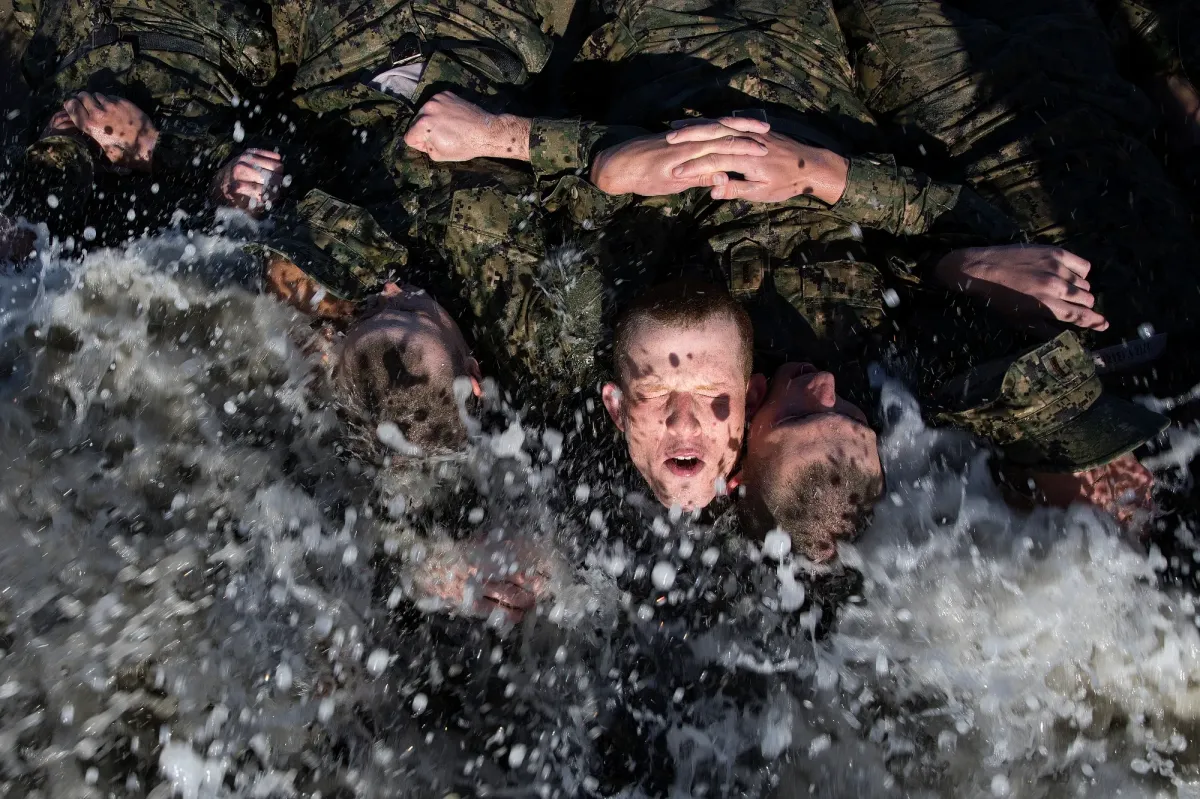
Discipline Without Structure: Why Hard Training Fails
Discipline is celebrated in military and tactical culture.
Show up.
Push through.
Do the work no matter what.
Discipline matters. But discipline alone is not enough.
When discipline is applied to a poorly structured system, it accelerates failure instead of preventing it. Walk into any unit gym and you will find someone who never misses a session, never skips a rep, and still cannot move their numbers. They are not lazy. They are disciplined people running an unstructured plan, and that combination quietly produces stalled progress, nagging injuries, and eventually burnout. The problem is not their work ethic. It is that effort without a system has nowhere productive to go. This post breaks down why discipline without structure fails tactical athletes over the long term, what structure actually does to your training, and how to stop hard work from turning into wasted capacity. It also explains what a real system looks like, and why purpose built tactical fitness programs exist to solve exactly this problem.
It is not only a military problem. A patrol officer who lifts heavy five days a week with no plan, a firefighter who runs the same metabolic circuit every shift, a selection candidate who rucks until something breaks, all of them are disciplined, and all of them are capped by the absence of a system. Tactical athletes are especially exposed to this because the culture rewards visible effort over invisible planning. The grind is admired; the rest day is suspect. That bias is exactly what makes structure hard to adopt and valuable once it is.
Discipline Amplifies the System You Are In
Discipline does not discriminate. It magnifies whatever structure exists. If the system is intelligent, discipline produces progress. If the system is flawed, discipline produces faster burnout and injury. This is why highly disciplined people often break first. They follow bad plans more consistently.
Picture two soldiers preparing for a ruck-heavy selection. One runs the same five-mile route at the same pace six days a week. The other follows a plan that rotates intervals, tempo work, easy aerobic volume, and a true recovery day. Both are equally disciplined. Twelve weeks later the first soldier has shin splints and a flat aerobic base, while the second has added measurable speed and durability. Discipline did not separate them, the structure their discipline was poured into did. This is the uncomfortable part for high-effort people: the harder you push, the faster a flawed plan delivers you to its failure point. The same gap shows up at the unit level, which is why the choice between unit PT versus a structured app decides how much of your effort actually turns into adaptation.
Structure Directs Discipline Productively
Structure determines where effort goes.
It decides:
What qualities are trained
How stress is applied
When recovery occurs
How progression unfolds
Without structure, discipline becomes blind effort. Blind effort feels virtuous. It is also inefficient. Structure works because adaptation is a response to a specific, repeatable stimulus, not to raw effort. When you apply a training stress, recover, and then apply a slightly larger stress, the body rebuilds above its previous baseline, a pattern sports science calls supercompensation, and the foundation every intelligent program is built on. Blind effort ignores the cycle. It keeps piling on stress without ever scheduling the recovery that converts that stress into progress. The result is a tactical athlete who trains constantly, feels constantly tired, and adapts to almost none of it. Structure is simply the decision to train the cycle instead of fighting it.
Why Discipline-First Cultures Resist Structure
Structure requires planning. Planning requires admitting uncertainty. Discipline-first cultures often resist this. They prefer simple rules.
Train harder.
Do more.
Don’t complain.
These rules are easy to enforce. They are not effective for long-term development. It is worth being fair to where these rules come from. "Train harder, do more, do not complain" exists because it is simple to teach, simple to enforce across a large group, and it filters for grit. In a basic-training environment with hundreds of recruits, that simplicity has real value. The failure happens when the same blunt instrument gets used to build long-term performance in an individual who already has grit. At that point "do more" stops being a standard and becomes a substitute for thinking. The honest verdict: discipline-first culture is an excellent starting filter and a poor long-term operating system. Programs built for tactical athletes diverge sharply on this point, and a side by side tactical fitness training program comparison makes the difference between grit-first and structure-first programming obvious.
Fatigue Erodes Discipline Over Time
Discipline relies on energy. Chronic fatigue drains it. When training systems ignore recovery, discipline erodes naturally. People feel less driven. They blame themselves. In reality, the system consumed their capacity. This creates a cycle of guilt and overexertion. It ends in burnout. This is the clearest evidence that toughness is not a training strategy, because no amount of grit lets you out-will accumulated fatigue.
There is measurable physiology behind this. Hans Selye's General Adaptation Syndrome described how an organism moves from alarm, to resistance, to exhaustion when stress is applied without relief, and chronic training with no recovery walks athletes straight into the exhaustion phase. Sport scientists later formalized the cost in the 2013 ECSS/ACSM consensus statement on overtraining (Meeusen et al.), which separates functional overreaching, where performance dips and then rebounds after rest, from non-functional overreaching and overtraining syndrome, where weeks or months of inadequate recovery produce prolonged maladaptation and falling output. The disciplined athlete who refuses to back off is the most likely to cross that line, because their work ethic removes the natural brake fatigue is supposed to apply.
Structure Creates Sustainability
Sustainable systems allow discipline to persist.
They include:
Planned intensity variation
Progressive loading
Recovery periods
Adjustments for stress
These elements protect long-term effort. They do not eliminate hard work. They direct it. Discipline is assumed. Structure makes it productive.
In practice, sustainability is not vague, it is a set of decisions with numbers attached. A structured plan might hold most aerobic running at a conversational, easy intensity and reserve only one or two sessions a week for genuinely hard work. It might add load to a lift in small five- to ten-pound increments rather than chasing a new max every session. It might schedule a planned deload every fourth week, cutting volume by roughly forty to fifty percent so the body can absorb the prior block. None of this is soft. Each decision exists so that twelve weeks of training actually compounds instead of grinding the athlete down to a baseline they never escape. Remove any one of those elements and you get the outcome most tactical athletes know well: a plateau despite training hard week after week with nothing to show for it.
Why Motivation Fades in Unstructured Systems
Motivation often disappears before physical failure. This is misinterpreted as weakness. In reality, motivation fades when effort stops producing results. Structure restores feedback. Progress becomes visible. Motivation returns naturally. This is not psychology. It is cause and effect.
The mechanism is straightforward once you stop calling it a willpower problem. Motivation is sustained by a visible return on effort. When a plan produces no measurable change, no faster two-mile, no heavier deadlift, no easier ruck, the brain correctly concludes that effort is not paying off and dials down the drive to repeat it. That is not weakness; it is an accurate read of a broken feedback loop. Structure fixes the loop by making progress trackable and incremental, so the athlete can see the line moving. The drive that felt like it had evaporated tends to return on its own once the work starts producing results again.
Discipline Should Support Adaptation, Not Punishment
The purpose of discipline is to follow a process. Not to endure punishment. Training should create adaptation. When discipline is used to enforce suffering instead of progress, the system fails its people. This distinction is critical.
This is where a lot of tactical training quietly goes wrong. Sessions get designed to be hard for the sake of being hard, smoke sessions that leave everyone wrecked but adapt no specific quality. Suffering becomes the goal, and "discipline" becomes the word used to justify it. But the body does not adapt to suffering; it adapts to a targeted, recoverable dose of the right stress. The embrace the suck mindset is a genuine asset when it is pointed at a session that was built to produce an adaptation, and pure waste when it is pointed at a session built only to hurt.
A session that destroys you and teaches your body nothing is not discipline working, it is discipline being wasted. The job of a good plan is to point that discipline at a clear adaptation and then get out of the way.
Long-term Performance Requires Restraint
Restraint is often mistaken for softness. It is not. Restraint allows accumulation of progress. Elite performers know when to push and when to hold back. That balance requires structure. Discipline alone cannot provide it. It is also the quiet reason most hard-working people stop short of reaching elite fitness levels: they have the effort, but never the restraint to let it accumulate.
Look at how elite endurance and tactical athletes actually train and the restraint is obvious. They run most of their easy days genuinely easy, they taper hard work down before a key event, and they treat recovery weeks as non-negotiable parts of the plan rather than admissions of weakness. The reason is not that they care less. It is that peak output on the day that matters is the product of months of accumulated, undamaged progress. Pushing maximally every session feels disciplined and reads as commitment, but it spends tomorrow's adaptation to feel productive today.
A simple field test tells you which situation you are in. If your hard sessions are getting at least slightly easier at the same output across a four- to six-week block, your discipline is being converted into adaptation and the structure is working. If every session feels equally brutal week after week, your numbers are flat, and your sleep and mood are sliding, your discipline is being spent rather than invested. The fix in that second case is almost never "try harder." It is to impose structure, planned intensity, progression, and recovery, so the effort you are already giving finally has somewhere to land.
None of this is an argument against discipline. Discipline is the engine, without it, the best program on paper never gets executed. The argument is that an engine needs a transmission. Structure is what turns raw output into forward motion instead of heat and noise. Build the system first, then let your discipline run it hard. That is how tactical athletes keep progressing for years instead of burning out in months.
Discipline gets people started.
Structure keeps them going.
FAQ
Is discipline enough to succeed in training?
No. Discipline without structure often leads to burnout or injury.
Why do disciplined people still fail?
Because discipline amplifies poor programming.
What matters more than discipline?
Structure that directs effort toward adaptation.
Can discipline and structure coexist?
Yes. Structure makes discipline effective.
References
Selye, H. (1956). The Stress of Life. McGraw-Hill. (General Adaptation Syndrome: alarm, resistance, exhaustion.)
Meeusen, R., Duclos, M., Foster, C., Fry, A., Gleeson, M., Nieman, D., Raglin, J., Rietjens, G., Steinacker, J., & Urhausen, A. (2013). Prevention, diagnosis and treatment of the overtraining syndrome: Joint consensus statement of the European College of Sport Science (ECSS) and the American College of Sports Medicine (ACSM). European Journal of Sport Science, 13(1), 1–24.


