
Strength Training vs Power Training: What's the Difference
Strength Training vs Power Training: Which Builds Tactical Performance?
In tactical fitness, strength training is treated as the foundation of performance, the ability to lift, carry, drag, and control heavy loads under fatigue is non-negotiable for military, law enforcement, and firefighting work. But maximal strength alone is not enough. Most real-world tasks also demand the ability to produce force fast: closing distance, breaching a door, clearing an obstacle. That is power, and it is a separate quality with its own training rules. The difference between strength training and power training is simple to state and easy to get wrong in programming. This guide breaks down what each one builds, why strength comes first, and how tactical athletes train both. If you are training toward a service standard, our military training systems build both qualities in the correct order so nothing gets skipped.
What Is Strength Training?
Strength is the ability to produce force against resistance. More precisely, strength is your ceiling for force output: how much load your muscles and nervous system can overcome regardless of how long it takes. It is built through high mechanical tension, heavy loads moved deliberately, which drives motor unit recruitment and the structural adaptations that raise that ceiling. Strength training generally lives at or above roughly 85% of your one-rep max for low repetitions. For tactical athletes this matters because the heaviest tasks you face, a casualty drag, a loaded ruck, manhandling a downed gate, are absolute-strength problems first.
If the load exceeds your ceiling, technique and willpower will not move it. This is also where a structured program pays off, and it is worth understanding how app-based training versus Crossfit shapes the way that strength ceiling actually gets built.
It is typically developed through:
Heavy resistance training
Lower repetition ranges
Slower, controlled movements
High levels of muscular tension
Examples of strength-based tasks:
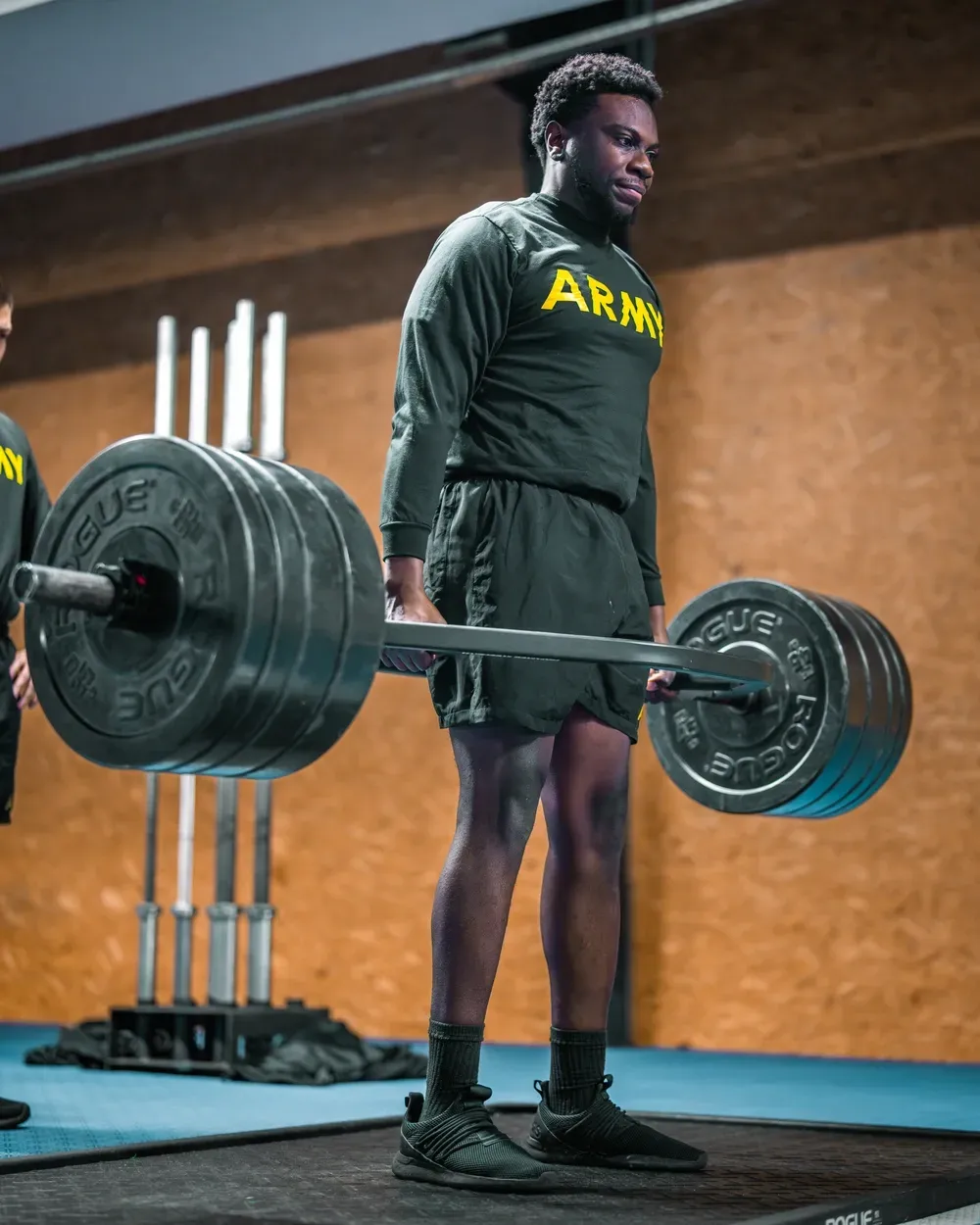
Deadlifting heavy equipment
Carrying a casualty
Forcible entry with tools
Lifting heavy objects overhead
Strength is the foundation for:
Load carriage
Injury prevention
Joint stability
Force production
Research consistently shows that greater muscular strength is strongly associated with improved occupational and athletic performance, Suchomel and colleagues (2016) document this relationship across a wide range of athletic and tactical tasks. If you are choosing where to start, it helps to see several tactical fitness programs compared before committing to one approach.
What Is Power Training?
Power is the ability to produce force quickly. It is defined as:
Power = Force × Velocity
That equation is the whole story: power is not just how much force you can produce, but how fast you can produce it. The key quality here is rate of force development, how quickly you can reach high force output from a standing or static start. Most tactical actions give you a fraction of a second, not the several seconds a maximal deadlift allows. Power training therefore lives further down the force-velocity curve: moderate loads, roughly 30 to 60 percent of max, moved with maximum intent. The goal of every rep is speed, not grind. Once bar speed drops, the power stimulus is gone. If you want the mechanical breakdown, our explainer on how power differs from strength covers the force-velocity trade-off in detail.
Power is developed through:
Explosive movements
Moderate loads moved quickly
Plyometrics
Sprinting
Jumping
Olympic-style lifts
Examples of power-based tasks:
Sprinting toward a threat
Jumping or climbing obstacles
Rapid direction changes
Explosive breaching actions
Short, high-intensity pursuits
Research shows that power output is a key factor in many athletic and occupational tasks requiring speed and rapid force production, and Cormie and colleagues (2011) detail how this neuromuscular power is developed and expressed.
Why Tactical Athletes Need Both
Real-world tactical tasks are unpredictable. Some require maximum strength, while others require rapid force. The problem is that the field does not let you choose which quality you will need. A single callout can demand a one-rep-max effort and a maximal sprint within the same two minutes, with a ruck on your back for both. An operator who trains only heavy lifts moves loads well but accelerates slowly; one who trains only jumps and sprints is explosive but folds the moment the load gets heavy. Tactical readiness is the overlap of both qualities, not a specialization in either. The examples below show how common tasks split across the strength–power spectrum.
For example:
Lifting a Casualty
Primarily strength
Sprinting to Cover
Primarily power
Forcible Entry
Combination of strength and power
Climbing Obstacles
Requires both strength and explosive movement
Research in military populations shows that performance in tactical tasks is influenced by multiple physical qualities, including strength, power, and endurance. Training only one quality creates performance gaps. Building all of them together is the idea behind a multi-modal conditioning model, which trains strength, power and endurance as one system rather than in isolation.
Why Strength Is the Foundation
Power cannot be developed effectively without strength. The reason is mechanical: power is force multiplied by velocity, so a higher force ceiling raises the entire power curve. You cannot express force quickly that you cannot produce at all. This is why a stronger athlete almost always has a higher power ceiling than a weaker one at the same body weight, there is more force available to move fast. Strength also builds the "reserve" that keeps explosive work safe: tendons, joints, and connective tissue that tolerate the high loading rates of jumps, throws, and Olympic lifts. Build the base first, and power training has something to convert. Skip it, and you are sprinting on a foundation that cannot support the output.
Stronger athletes:
Produce more force
Generate more power
Handle explosive movements more safely
Resist fatigue more effectively
Research shows that increases in maximal strength often lead to improvements in power output. Without a strength base, power development is limited.
How Strength Training Is Typically Structured
Strength sessions usually include:
Heavy compound lifts
Lower repetition ranges
Longer rest periods
Examples:
Squats
Deadlifts
Presses
Rows
Loaded carries
Typical parameters:
3–6 sets
3–6 repetitions
Heavier loads
Full recovery between sets
Purpose:
Increase force production
Improve joint stability
Build structural resilience
The logic behind these numbers is intent, not just load. Heavy compound lifts in the 3-to-6-rep range force maximal motor unit recruitment, while the long rest periods exist so each set is performed fresh rather than under accumulating fatigue, quality of force production is the target, not exhaustion. Progressive overload ties it together: small, planned increases in load over weeks are what actually raise the strength ceiling. Random heavy days without progression maintain strength but rarely build it.
How Power Training Is Typically Structured
Power sessions emphasize:
Speed
Explosiveness
Rapid force production
Examples:
Box jumps
Broad jumps
Medicine ball throws
Sled sprints
Olympic lift variations
Short sprints
Typical parameters:
3–5 sets
2–5 repetitions
Moderate loads or bodyweight
Full recovery between sets
Purpose:
Improve reaction speed
Enhance movement efficiency
Increase explosive capability
Notice the parameters mirror strength work in one way and diverge in another: reps stay low and recovery stays full, but the loads drop and the intent flips entirely to speed. That is deliberate. Power is a high-quality, low-fatigue stimulus, the moment bar or body speed slows, you are no longer training power, you are training fatigue resistance. Keep the volume crisp: a handful of fast, technically clean reps beats long grinding sets. This is also why power work is best placed early in a session, before strength or conditioning has blunted your ability to move fast.
Common Training Mistakes
Most programming errors with strength and power come from treating them as the same quality or as rivals competing for the same slot. They are neither. The three mistakes below are the ones that quietly cap tactical performance, not because the training is hard, but because it is unbalanced or unstructured.
Only Training Strength
Heavy lifting alone may lead to:
Slower movement speeds
Poor acceleration
Reduced agility
Only Training Power
Explosive work without strength:
Limits force production
Increases injury risk
Reduces load tolerance
Randomly Mixing Both Without Structure
Unplanned training:
Reduces effectiveness
Increases fatigue
Limits long-term progress
Strength and power should be developed with clear intent.
Practical Takeaways
The sequencing is what most people get wrong, so make it explicit: strength is the deposit, power is the interest it earns. Spend the first block of training building a force base, then layer explosive work on top once that base can support it, not the other way around. In practice both qualities can and should be trained in the same week, often the same session, with power placed first while you are fresh and heavy strength work after. Match the emphasis to your job: a load-heavy role leans strength, a pursuit-and-breach role leans power, but neither athlete can afford to abandon the other. If you are comparing options at the program level our breakdown of Combat Fitness versus other training programs shows how design changes with the mission.
To balance strength and power:
Build a solid strength foundation first
Add explosive movements gradually
Train both qualities each week
Use structured progression
Match training to real-world demands
Strength allows you to move heavy loads.
Power allows you to move quickly and decisively when it matters most.
Tactical performance depends on both. That same principle applies outside the job too, which is why everyday fitness for dads matters for anyone who needs to stay capable for their family.
References
Suchomel, T. J., et al. (2016). The importance of muscular strength in athletic performance.
Cormie, P., et al. (2011). Developing maximal neuromuscular power.
Stone, M. H., et al. (2003). Maximum strength–power relationships.


