
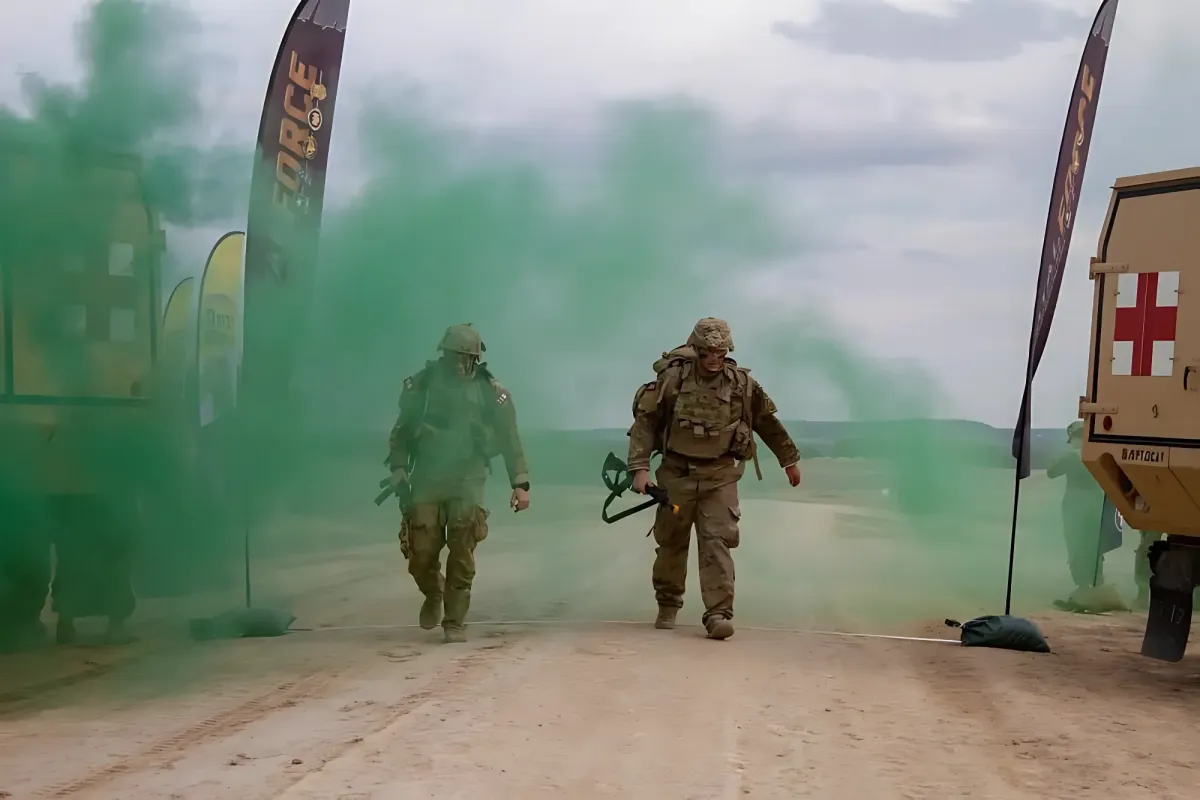
Capacity vs Capability: Train for Tactical Performance
Capacity and capability sound like synonyms, but for tactical athletes they decide two completely different outcomes. Capacity is how much work your body can produce. Capability is how much of that work survives contact with load, fatigue, and chaos in the field. Confusing the two is the most common reason fitness that looks elite on a test sheet falls apart under real demand.
Too many athletes train for capacity and assume capability will follow. That's like building a powerful engine and never checking whether the tires can hold the road. The engine isn't the problem, the unbuilt rest of the vehicle is.
This guide breaks down the difference so you can train smarter, judge progress honestly, and build performance that holds up when the conditions aren't perfect, which, for military, law enforcement, and first responders, is most of the time. It is the same distinction that separates purpose-built military fitness programs from generic strength plans that only ever get tested in ideal conditions. That gap also explains why training platforms diverge so sharply once you look past the exercise library, and why a head-to-head like Combat Fitness vs alternative training programs comes down to whether a program trains capacity in isolation or trains its expression under load.
What “Capacity” Really Means
Capacity is a measure of how much work your body can do within a specific domain or under specific conditions. Think of capacity as your physical ceiling in a particular quality.
Examples of capacity include:
Aerobic capacity (how much sustained work your cardiovascular system can support)
Strength capacity (how much force you can produce)
Work capacity (how much total effort you can handle in a session)
Endurance capacity (how long you can sustain effort before decline)
Notice what these share: each is a ceiling measured in isolation. A heavy deadlift, a fast two-mile, a big aerobic engine, these are real, trainable qualities, and you should build every one of them. But a test-day number tells you what your system produces when everything is dialed in: rested, fueled, warm, and unloaded. That's useful information. It just isn't the whole picture. Capacity is the size of the tank. It says nothing about how cleanly the engine runs once the terrain turns against you.
Capacity is measurable. You can quantify it. You can test it repeatedly and track trends over time. For tactical athletes, capacity is the raw material. A heavy deadlift, a deep aerobic base, and high work capacity all expand the ceiling of what you could theoretically do. But capacity is domain-specific and easy to misread. A soldier can post elite aerobic capacity on a clean treadmill test and still gas out on a loaded ruck across broken terrain.
That misread is baked into how most standard sessions are run, which is the real substance of Combat Fitness versus unit PT: one builds toward a test score, the other builds toward the task the score is supposed to predict. That gap is exactly why we measure capacity carefully but never mistake the measurement for the finished product. It tells you the size of the engine, not whether the vehicle can actually finish the route. But there’s a nuance: capacity does not tell you how well you apply it under real-world conditions.
What “Capability” Really Means
Capability is the expression of capacity in context. It’s about applying your physical capacities to meet specific performance outcomes in real, unpredictable conditions.
Capability is not just strength or endurance. Capability is:
Strength under fatigue
Speed under load
Endurance under variable intensity
Movement quality while cognitively loaded
Every item on that list shares a condition the test removes: stress. Strength under fatigue is a different quality than a fresh one-rep max. Endurance under variable intensity is a different quality than a steady-state run. Capability is what survives once you add load, time pressure, decision-making, and the friction of a real task. This is the quality that decides outcomes in tactical work, where the environment is hostile, the load is fixed, and nobody waits for you to be ready. Build capacity and you raise the ceiling; build capability and you earn access to it.
Where capacity tells you what your system has, capability tells you what your system can do when it matters. Capability is where the mission actually gets decided. It answers a harder question than any single test: can you produce force, hold pace, and move cleanly when the conditions are ugly and the outcome matters? For military, law enforcement, and first responders, almost every real task is a capability task, strength after a sprint, decisions under load, endurance with the heart rate already spiked. Capacity sets the upper limit. Capability determines how much of that limit survives contact with stress, fatigue, and the unpredictability of the field. This is especially important in tactical, hybrid or functional performance domains where environment, stress, load, and unpredictability are part of the game, and it is a large part of what defines a hybrid athlete: the capacity to run and lift, and the capability to do both when neither is convenient.
Capacity Without Capability: A Common Gap
A powerful athlete with high VO2 max, but no ability to apply that fitness in the face of stressors, might be fit on paper but less effective in performance reality. Let’s say two athletes have the same aerobic capacity. One can maintain pace, power, and movement economy under stress and ambiguity. The other struggles when the task isn’t “perfect conditions.” The difference isn’t capacity, it’s capability.
Consider a patrol officer who can back-squat 400 pounds but has never trained to drag a downed partner after a foot pursuit. The strength capacity is there; the capability to express it, fatigued, adrenalized, in body armor, was never built. This is the most common and most dangerous gap in tactical fitness: athletes stack impressive numbers in controlled settings, then discover under real demand that those numbers don't fully transfer. Capacity built in isolation is a promise. Capability is whether that promise gets kept when it counts.
In real world tasks, whether tactical operations, long missions, endurance sports, or high intensity competitions, capability trumps raw capacity because performance is rarely linear or isolated. The trap is that capacity is easy to chase and easy to measure, so it quietly becomes the goal. You watch your numbers climb and assume readiness climbs with them. But the soldier, officer, or firefighter who tests well and performs poorly under stress is a familiar story, strong on paper, fragile in the field. The fix isn't to abandon capacity work. It's to stop treating a test score as proof of performance, and start asking whether that capacity holds up when the conditions stop cooperating.
Why This Distinction Matters
This isn't an abstract debate, it directly shapes how you program. The mistake is rarely training too little; it's training hard in only one dimension and assuming the rest follows. Capacity-first programming is seductive because every variable is clean and every gain is visible on a spreadsheet. But the gains that matter most in tactical work are the messy ones: expressing strength when you're already smoked, holding form when your heart rate is pinned, recovering fast enough to go again. A capacity-only plan never trains those, because they don't show up on a single-quality test.
When you think purely in terms of capacity you might design training like this:
Longer runs to build aerobic capacity
More reps at a certain percentage to build strength capacity
Bigger volume day after day to increase work tolerance
But in the real world:
You need to express strength after fatigue
You need to maintain movement quality under stress
You need to recover between hard efforts
That’s capability. The practical consequence is simple: capacity-only programming quietly optimizes for the test instead of the task. You get better at the controlled measurement and assume field performance comes along for free. It usually doesn't. A program that builds capacity but never stresses how that capacity is expressed leaves a blind spot exactly where performance breaks down, under fatigue, under load, and under the cognitive noise of a real environment. Training the expression of fitness, not just its size, is what closes that gap.
If training is only capacity-based, you may miss how your body expresses that capacity under context, and that’s where performance breakdown happens.
Training for Capability, Not Just Capacity
None of this means throwing out your capacity work, it's the raw material, and you can't express what you don't have. It means wrapping that capacity in conditions that force it to perform. Four shifts move training from building numbers to building usable performance:
1. Contextualize the Stress
Move beyond isolated metrics (like max VO2 or 1-rep max). Design sessions that mimic the demands you’ll face: repeated high intensity, transitions between modalities, load carriage, changes of direction, cognitive stress. The goal is to rehearse the conditions, not just the movement. A clean set of squats and a set of squats after a 600-meter sprint with a ruck on your back are different stimuli, and only one of them resembles the job. Context beats equipment here, and hybrid training with limited equipment proves the point: a sandbag, a ruck, and rough ground will build more capability than a full rack used only in perfect conditions.
2. Mix Modalities
Training strength and conditioning separately builds capacity. Training them together builds capability, the ability to apply strength when fatigued or to sustain load at variable intensity. Concurrent demand is where capability is forged, and a multi-modal conditioning model shows how pairing strength with conditioning teaches your system to hold output as fatigue accumulates, exactly the transfer real tasks require.
3. Prioritize Transferable Patterns
Train movement quality under stress. Not just how long you can run, but how well you can run with load, terrain change, or after strength efforts. Load it, tilt the ground, add fatigue, then watch what your movement does. Quality that survives those conditions is quality you can actually deploy.
4. Track Performance Outcomes
Instead of just tracking numbers (time, reps, weights), track how performance holds up under multi-stage testing or when combining qualities. Single numbers flatter you. Multi-stage tests that stack qualities, strength, then endurance, then a skill under fatigue, tell you whether your capacity is genuinely usable, not just present.
This is the difference between building an engine and building a vehicle that can navigate rough terrain. None of this means abandoning capacity work, you can't express strength you never built. The sequencing is what matters: develop the capacity, then deliberately train its expression under the conditions you'll actually face. That's the logic behind structured tactical programming, where strength, conditioning, and load carriage are layered so the qualities collide under fatigue instead of living in separate sessions. The athletes who perform when it counts are rarely the ones with the single highest number, they're the ones whose training rehearsed the real demand before it arrived.
Real Examples
Think about two athletes preparing for the same tactical test:
Athlete A increases their treadmill VO2 max but only trains in controlled conditions.
Athlete B works in loaded circuits, varied terrain, short interval bursts, and repeated strength sequences under fatigue.
Both have similar raw capacity numbers. But Athlete B’s capability, the way they use their capacity under realistic stress, is higher. That’s performance. Capability isn’t just the highest number you can hit in a lab. It’s how well you express your fitness when the environment, stress, and task demands aren’t perfect.
The lesson isn't that Athlete A wasted their time, a bigger engine is never a liability. The lesson is that Athlete A stopped one step short. They built the capacity and never trained the expression of it, so on test day the gap shows up as hesitation, early fatigue, and movement that falls apart under load. Athlete B trained the same engine inside the conditions they'd be tested in, so their fitness arrives intact when the whistle blows. Same raw numbers, different outcome, and the outcome is the only thing that counts.
What Science Says About Capacity vs Capability
This isn't just coaching philosophy, it tracks with how adaptation actually works. The principle of specificity, often called the SAID principle (Specific Adaptation to Imposed Demands), holds that the body adapts to the precise stress imposed on it. That specificity runs deep: strength gains, for example, tend to be greatest at or near the velocity you actually train (Behm & Sale, 1993). More broadly, strength, power, and muscular-endurance adaptations all depend on exercise selection, load, and training volume, so transfer to a given task is strongest when training resembles that task (Kraemer & Ratamess, 2004).
In plain terms: capacity built in isolation transfers narrowly, while capacity trained in context transfers where it counts. That's why a single-variable test, a treadmill VO2 max, a one-rep max, predicts real-world performance far less reliably than training and testing that combine the qualities under realistic demand. The takeaway for athletes and coaches is to design programs that rehearse how capacity is expressed in real movement, not just how large it is in isolation.
The research backs the priority. In his review of training transfer, Issurin (2013) shows that adaptations carry over to a target task only when the training stimulus matches the specific demands of that task, generic work tends to produce generic, and often disappointing, transfer. The tactical literature is even blunter. In a critical review of fitness testing across military, law enforcement, and firefighter populations, Orr and colleagues (2021) found that no single generic fitness test reliably predicts occupational task performance, and that assessments built around real job demands track real-world capability far more closely. Translated into training terms: capacity built in isolation does not automatically become capability. You have to train the expression of it, deliberately and in context.
Bottom Line: Train for Realism
Capacity is absolutely important, it’s the foundation. But capability is where performance lives. A well-designed training plan develops capacity and ensures that capacity is expressed properly in real world settings. That’s what separates an athlete who is “fit on paper” from one who is truly capable in performance.
For tactical athletes, that distinction isn't academic, it's the difference between a number that looks good in the logbook and performance that holds when a partner needs dragging, a ruck runs long, or a shift turns into a fight. If you want the definitions stripped to their simplest form, we cover capacity versus capability explained as a standalone primer.
Build the capacity. Then earn the capability by training it under the load, fatigue, and unpredictability you'll actually meet. Capacity is the foundation; capability is the build standing on top of it.
As your training evolves, ask yourself:
Am I building stamina or just long distance capacity?
Am I improving strength, or strength under fatigue?
Am I testing performance in conditions that resemble what I’ll actually face?
Those questions shift training from good to meaningfully effective.
So build your capacity without apology, it's the raw material, and you can't express what you don't have. Then spend the back half of every training block making sure that capacity actually shows up under load, under fatigue, and under the kind of stress a test day never simulates. That second step is what turns a strong body into a capable operator.
References
Behm, D. G., & Sale, D. G. (1993). Velocity specificity of resistance training. Sports Medicine, 15(6), 374–388.
Issurin, V. B. (2013). Training transfer: scientific background and insights for practical application. Sports Medicine, 43(8), 675–694.
Kraemer, W. J., & Ratamess, N. A. (2004). Fundamentals of resistance training: progression and exercise prescription. Medicine & Science in Sports & Exercise, 36(4), 674–688.
Orr, R., Sakurai, T., Scott, J., Movshovich, J., Dawes, J. J., Lockie, R., & Schram, B. (2021). The use of fitness testing to predict occupational performance in tactical personnel: A critical review. International Journal of Environmental Research and Public Health, 18(14), 7480.


